Glassdoor · Employer Guide
How to Remove Glassdoor Reviews: What Employers Can and Can’t Do (2026-2027 Guide)
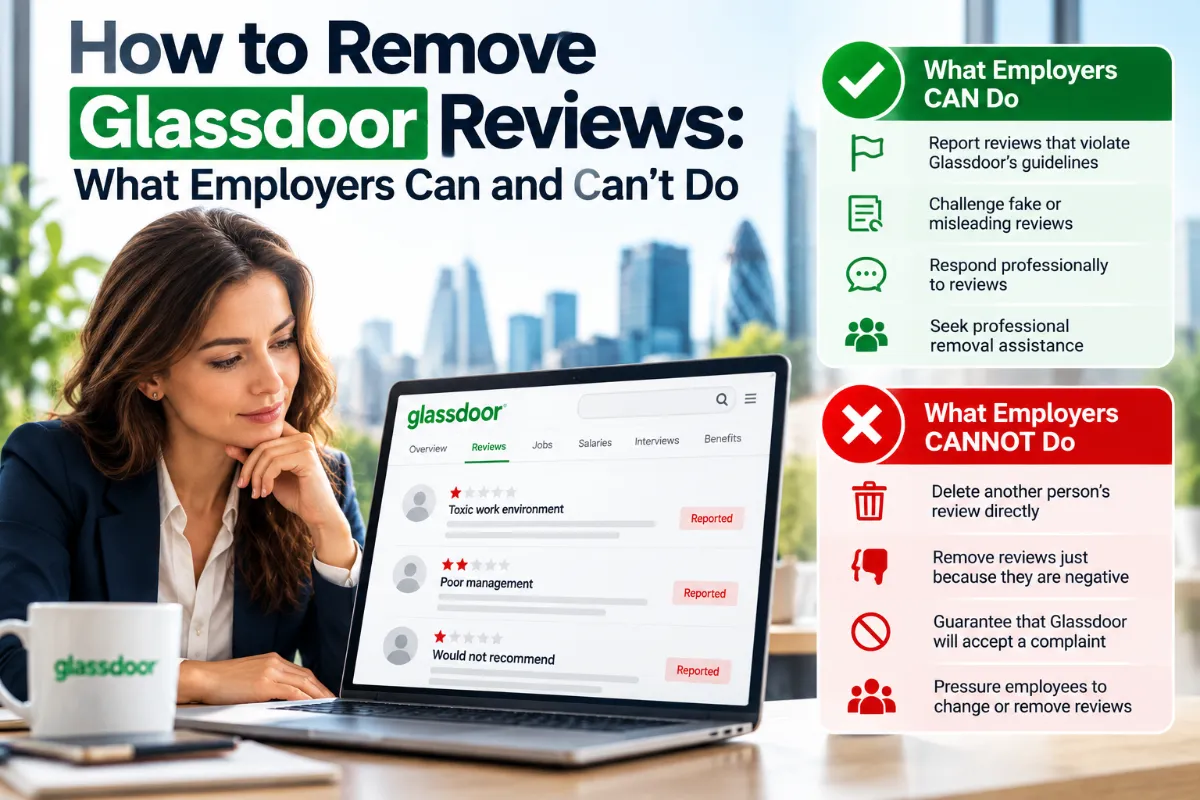
Can you delete Glassdoor reviews? Not yourself — but the ones that break Glassdoor’s rules can be removed. A single bitter Glassdoor review can sit at the top of your company profile for years, putting off the candidates you most want to hire. This guide explains exactly what Glassdoor allows employers to do, what it never allows, which reviews can actually be removed, and how to get the unfair ones taken down — fast and without breaking any rules.
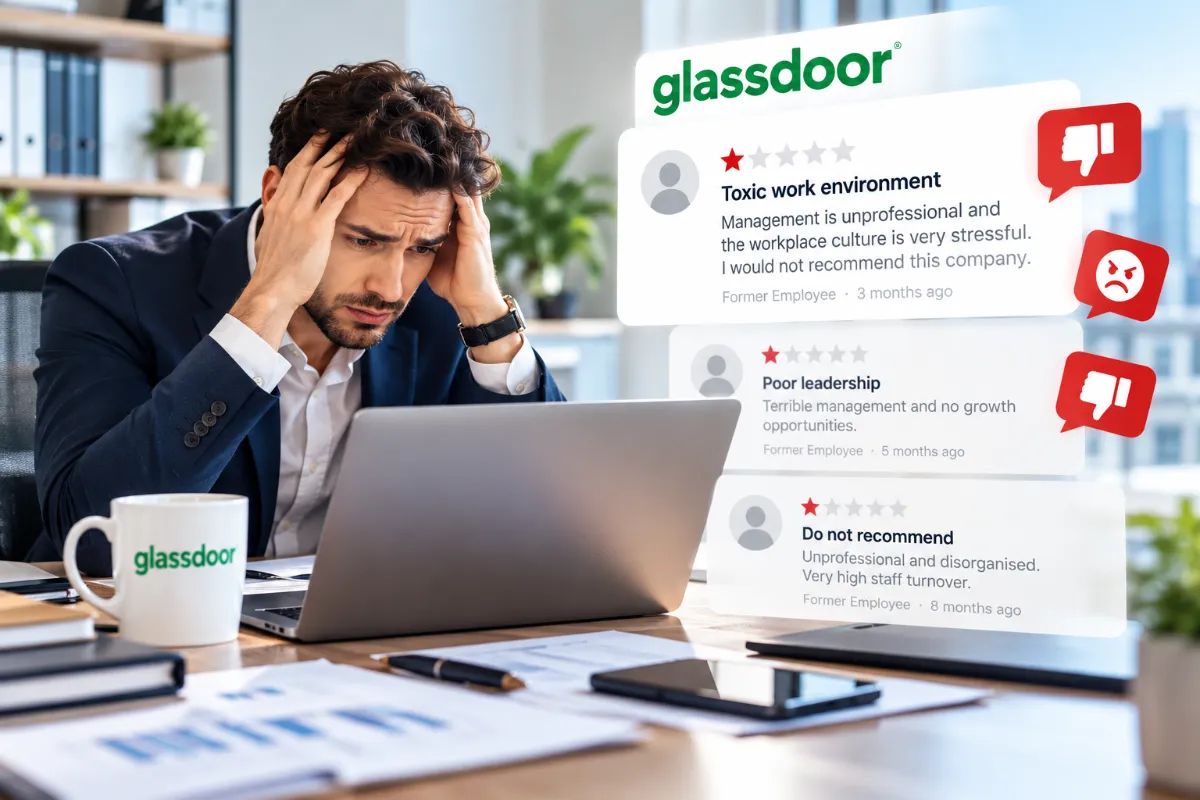
It’s Monday morning. Your best candidate of the year has just withdrawn. Their reason, in one polite line: “I read some reviews.” You open Glassdoor and there it is, pinned near the top of your profile — a one-star review from someone who left eight months ago, naming your operations manager and calling the whole company “a scam.”
If that feels familiar, you’re not alone, and you’re not powerless. Glassdoor won’t let you delete a review, but it does remove reviews that break its rules — and far more reviews break those rules than most employers realise. The trick is knowing exactly where the line sits, and how to prove a review has crossed it. That’s what this guide is for.
👉 As an employer, you cannot delete real Glassdoor reviews — but ReviewsEraser.com can. We remove any type of Glassdoor review, including genuine negative ones, usually within 96 hours, at a fixed price with a 100% removal guarantee. Get your Glassdoor review removed →
📌 Key takeaways
- Employers cannot delete Glassdoor reviews themselves, and Glassdoor says it will not remove a review just because it is negative.
- Employers can flag reviews that break Glassdoor’s Community Guidelines, respond publicly for free, and encourage honest reviews.
- Employers cannot pay Glassdoor to remove reviews, offer incentives, pressure staff, or unmask anonymous reviewers on demand.
- Reviews that name and attack non-executive staff, leak confidential information, contain threats or personal data, or come from non-employees are the most likely to be removed.
- ReviewsEraser handles any type of Glassdoor review, usually within 96 hours, at a fixed price with a 100% removal guarantee.
🧭 In this guide
- Can you delete Glassdoor reviews?
- What employers can and cannot do
- Which reviews can be removed
- How to flag a review, step by step
- What happens after you flag it
- 3 real-world scenarios
- Legal routes and their risks
- Rules on asking for reviews
- Are Glassdoor reviews anonymous?
- How to respond to a negative review
- How ReviewsEraser removes reviews
- Frequently asked questions
- How ReviewsEraser Can Help
Can You Delete Glassdoor Reviews?
Yes — but not by deleting it yourself. Employers cannot delete or edit reviews on Glassdoor, and Glassdoor states it does not remove content simply because it is negative. A review is removed when it breaks Glassdoor’s Community Guidelines — for example, by naming and attacking a non-executive employee, revealing confidential company information, using threats or hate speech, or being posted by someone who never worked for you. Employers report these reviews by flagging them; Glassdoor’s moderators decide. ReviewsEraser’s Glassdoor review removal service builds and escalates these cases for you, usually within 96 hours.
Glassdoor matters because candidates use it before they apply, before interviews and before accepting offers. Glassdoor reports that in its own survey, 62% of job seekers said their perception of a company improved after seeing an employer respond to a review (Glassdoor) — which tells you how closely candidates read what is on your page.
Why one Glassdoor review can cost you hires
| What candidates do | What it means for you |
|---|---|
| 86% check company reviews and ratings before applying (Glassdoor data, via Lattice) | Your profile is read before your careers page |
| 65%+ of Glassdoor users read at least five reviews before forming an opinion (same source) | A bad review in your top five does disproportionate damage |
| 62% say their view of a company improves when it responds to reviews (Glassdoor) | Silence reads as “it’s true” |
| Recent reviews carry more weight in your overall rating | A single bad month can drag the score for a long time |
Layoffs make this worse. The Pragmatic Engineer reported one tech company whose score fell to 2.3 after cutting 30% of staff, leaving leadership chasing a return above 3.0 — the kind of number candidates notice instantly.
What Employers Can and Cannot Do on Glassdoor
What employers can do on Glassdoor
| Action | Allowed? | Notes |
|---|---|---|
| Claim a free employer account | Yes | Gives access to the Employer Center, review alerts and response tools |
| Flag reviews that break the guidelines | Yes | A human moderator checks every flagged review |
| Respond publicly to any review | Yes, free | One response per review; the reviewer is notified |
| Ask employees for honest reviews | Yes | Voluntary, with no rewards and no pressure |
| Update your company profile, photos and benefits | Yes | Helps balance what candidates see |
| Take legal action over unlawful content | Sometimes | High bar, costly, and can backfire |
What employers cannot do on Glassdoor
- Delete or edit reviews. Only Glassdoor (or the reviewer) can remove a review, and Glassdoor says it does not edit review text.
- Pay Glassdoor to remove reviews. Glassdoor states employers cannot pay to remove reviews and that the same rules apply to paying clients and non-clients (Glassdoor moderation explained).
- Get a review removed because it is negative or unfair. Honest opinions about pay, management or culture are allowed, however harsh.
- Offer incentives for reviews. Gift cards, prize draws, time off or “show me your review” requests breach Glassdoor’s rules; Glassdoor removes incentivised reviews when it finds them.
- Pressure or retaliate against reviewers. In the US, the National Labor Relations Act can protect employees who discuss working conditions with each other, and punishing a reviewer can create a separate employment claim.
- Unmask anonymous reviewers on request. Glassdoor protects reviewer anonymity and goes to court to defend it when needed.
- Post fake positive reviews. Reviews from managers, HR or friends posing as employees breach Glassdoor’s rules, and fake reviews are banned under the US FTC’s 2024 rule and the UK’s DMCC Act 2024.
5 Glassdoor myths employers still believe
| Myth | Reality |
|---|---|
| “If we advertise on Glassdoor, they’ll take bad reviews down.” | No. Glassdoor says paying clients and non-clients follow exactly the same rules. |
| “A false review will be removed once we explain it’s untrue.” | Rarely. Glassdoor can’t referee workplace disputes, so you need a guideline breach, not a counter-story. |
| “Our NDA means ex-staff can’t review us.” | Glassdoor doesn’t enforce private contracts. Only the courts can, and they set a high bar. |
| “Old reviews disappear eventually.” | Glassdoor doesn’t delete outdated reviews — though recent reviews carry more weight in your rating. |
| “Nothing can be done about an anonymous review.” | Anonymous reviews still have to follow the guidelines — and plenty don’t. |
Want a review gone without the guesswork?
Send us the link for a free check. We tell you within hours whether it can be removed — you only pay once we confirm.
Which Glassdoor Reviews Can Be Removed?
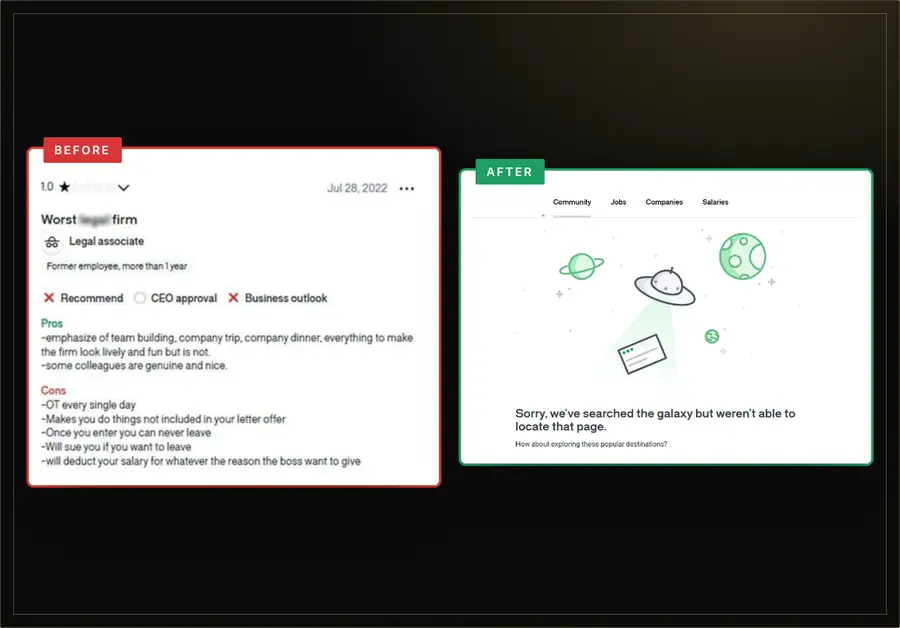
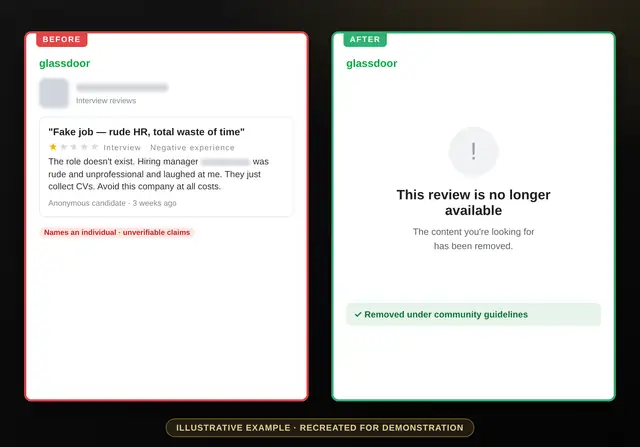
Glassdoor removes content that breaks its Community Guidelines. Glassdoor has said that around 5–10% of reviews are rejected under these guidelines (Glassdoor). In practice, these are the review types employers most often get removed:
| Review contains… | Removable? | Why |
|---|---|---|
| Names and attacks a non-executive employee | Yes | Glassdoor protects individual staff below senior leadership |
| Trade secrets or confidential company information | Yes | Non-public financials, client names, internal data |
| Threats, hate speech, profanity or harassment | Yes | Breaks the Community Guidelines |
| Personal information (phone numbers, addresses, health) | Yes | Privacy breach |
| Adverts, links or copied text | Yes | Spam |
| A review of the wrong company or location | Often | Not about your workplace |
| A second review by the same person within a year | Often | Glassdoor allows one review per company per year |
| A reviewer who never worked for you | Possible, with evidence | Reviewers self-certify, so proof matters |
| Breach of an NDA or non-disparagement clause | Rarely, by flag alone | Glassdoor does not enforce private contracts |
| False factual allegations (fraud, crime) | Possible via legal route | Defamation needs strong proof |
| Honest negative opinion | Not by a standard flag | Needs a specialist case — see how we remove these |
Tip: most removable reviews mix an allowed opinion with one rule-breaking sentence — a named team leader, a client name, a salary figure for a specific person. That sentence is your case. Quote it exactly when you flag.
60-second check: could your review be removed?
Read the review once and answer honestly. Every “yes” is a potential removal route:
- ☐ Does it name or clearly identify a staff member below senior leadership?
- ☐ Does it mention client names, revenue, unreleased products or other confidential details?
- ☐ Does it contain threats, slurs, sexual content or swearing?
- ☐ Does it share anyone’s phone number, address or health information?
- ☐ Does it describe a job title, office or event that never existed?
- ☐ Has the same person already reviewed you in the last 12 months?
- ☐ Does it accuse someone of a crime you can prove didn’t happen?
Scored zero? A standard flag probably won’t work — reply well and send it to us instead. Scored one or more? You have a case. Flag it with the exact words quoted, or send it to us for a free assessment.
Interview reviews, salary reports and CEO ratings
Glassdoor reviews aren’t the only thing on your profile. The same Community Guidelines apply to:
- Interview reviews — often the first thing a candidate reads. A review that names your recruiter, quotes confidential test questions or describes an interview that never happened can be flagged just like an employee review.
- Salary reports — anonymous pay data. Reports are aggregated, so an individual outlier rarely moves the averages much; the bigger risk is a review that ties a specific salary to a named person.
- CEO approval — calculated from reviewers’ answers. It can’t be flagged directly, but removing rule-breaking reviews removes their votes too.
How to Flag a Glassdoor Review, Step by Step
Source: Glassdoor Help Center – Flagging Content on Glassdoor. Use the 400 characters to name the guideline and quote the exact sentence that breaks it.
1Claim your free employer account
Sign up for a free Glassdoor employer account and verify that you represent the company. This unlocks the Employer Center, where you can monitor, flag and respond to reviews.
2Find the review and identify the breach
Read the review line by line and match it to one guideline: named individual, confidential information, threat, personal data, wrong company or not an employee.
3Flag it
In the Employer Center, open Reviews, select the flag icon on the review, choose the closest reason and send it. You can also report a review from the public profile using the menu on the review.
4Write a short, factual explanation
Name the guideline and quote the exact words that break it. For example: “This review names our junior payroll assistant and makes personal accusations against her, which breaches the guideline on naming non-executive employees.” Do not argue the reviewer’s opinions.
5Keep a record
Screenshot the review, note the date you flagged it and save your explanation. You will need it if you escalate.
What Happens After You Flag a Glassdoor Review?
- A human moderator checks it. Glassdoor uses automated screening for all content, but flagged reviews are reviewed by people.
- The reviewer is not told you flagged it. Glassdoor notifies the author only if the review is removed.
- There are three outcomes: the review stays, the review is removed, or the author is asked to edit it and it reappears without the offending part.
- Clearly false claims can be removed. Glassdoor stays neutral on disputed facts, but says it may remove a review that is obviously false based on reliable, independent information — for example, facts reported by a reputable news outlet (Glassdoor: when content is removed).
- Removed reviews can come back. If a review is removed, the author may be able to revise and resubmit it within 30 days. A cleaned-up version may reappear.
- Old reviews stay. Glassdoor does not remove reviews for being old, but new reviews must relate to a job or interview within the last five years.
- Decisions are final. Glassdoor says content decisions are not negotiable, so your first flag should be your best one.
- Re-flagging rarely helps. Flagging the same review again with a different reason is not a strategy; a better-prepared case or a different route is.
Why most employer flags fail
- The review is an opinion. “Toxic management” and “low pay” are allowed, however unfair they feel.
- The flag argues facts. Glassdoor says it cannot verify who is right in a workplace dispute, so “this is not true” is weak on its own.
- No specific guideline is named. Vague flags are easy to reject.
- The evidence comes from you. Glassdoor generally declines evidence from parties with a stake in removing a review, so the strongest flags rely on what is visible in the review itself — a name, a confidential detail, a job that never existed.
- The flag points to an NDA. Glassdoor does not enforce private contracts between you and former staff.
3 Real-World Glassdoor Review Scenarios (and What Works)
1The post-layoff pile-on
You cut 15 roles and, within a week, eight one-star reviews land, several with near-identical wording. What works: respond calmly to each, flag any that name individuals or reveal confidential restructuring details, and look for repeat posters. Glassdoor allows each member one review per company per year, so repeat posters are often removable. What doesn’t: asking the remaining team to “balance it out” — Glassdoor treats that as coerced reviewing.
2The named manager
A review calls your warehouse supervisor by first name and accuses her of bullying. What works: flag it under the guideline protecting non-executive staff, quoting the sentence that names her, and post a short reply that refuses to discuss individuals. This is one of the strongest removal cases there is.
3The “employee” who never was
A review describes a night shift you don’t run, at an office you closed in 2021. What works: flag it as not from a current or former employee and list the facts that can’t be true. Facts beat feelings every time.
Legal Routes for Glassdoor Reviews and Their Risks
Some reviews go beyond opinion: they accuse named people of crimes, invent events or leak trade secrets. Legal routes exist, but they are slow, public and expensive.
1Defamation
A review may be defamatory if it states something false as fact and damages your reputation. In England and Wales, a business must show the statement has caused or is likely to cause serious financial loss (Defamation Act 2013, section 1). Opinions such as “worst boss I’ve had” are not defamatory. See when a bad review becomes a legal case.
2Unmasking an anonymous reviewer
Glassdoor defends reviewer anonymity in court. In Glassdoor, Inc. v. Superior Court (2017), a California appeals court set aside an order to reveal a reviewer because the employer had not shown the review actually breached its confidentiality agreement (Justia summary). Expect to prove your case before any identity is disclosed.
3Privacy and GDPR
Where a review names an employee and shares personal details, that employee may have rights under the GDPR or UK GDPR. Read GDPR right to erasure and online reviews.
4The risks
Lawsuits can draw far more attention to a review than it ever had. Suing or threatening a former employee can also lead to a retaliation claim; the US National Labor Relations Act protects workers’ rights to discuss pay and working conditions, including online (Glassdoor). Use the legal route only for clearly unlawful content, with advice from a qualified lawyer.
Important: this guide is general information, not legal advice. ReviewsEraser works through platform reporting and official legal channels only, and never contacts or pressures reviewers.
The Rules on Asking Employees for Glassdoor Reviews
Encouraging honest reviews is the healthiest way to balance a few angry ones — and Glassdoor actively welcomes it. The line is between inviting reviews and buying or steering them.
| ✔️ Fine to do | ❌ Not allowed |
|---|---|
| Mention Glassdoor at an all-hands, in a newsletter or in onboarding | Gift cards, prize draws, extra leave or any reward for a review |
| Ask everyone, at natural moments (after 90 days, at anniversaries) | Only asking staff you know are happy |
| Say clearly that reviews are voluntary and anonymous | Asking to see the review, or for a screenshot as proof |
| Share the link to your Glassdoor profile | Managers or HR writing reviews posing as employees |
| Thank reviewers publicly through your employer response | Review “events” where staff write reviews in front of managers |
Why it matters: Glassdoor removes reviews it finds were incentivised or coerced, and it can place an alert on a company profile when it sees signs of inflated reviews — a public warning that does far more damage than any one-star review. In the US, the FTC’s 2024 rule on fake reviews also bans undisclosed reviews from company insiders and covers businesses that ask employees to post reviews without disclosure (summary of the FTC rule). The rule was written for consumer reviews, but it’s a strong signal of where regulators draw the line.
Copy-ready invite: “If you’d like to share your experience of working here, you can leave an honest review on Glassdoor. It’s completely voluntary and anonymous, and we won’t ask whether you’ve posted. Every review — good or bad — helps us improve.”
Are Glassdoor Reviews Anonymous?
Yes, to you — but not to Glassdoor, and not always to a court. Here’s what that means in practice:
- What you see: usually “Current Employee” or “Former Employee”, a job title, sometimes a location and how long they worked there — never a name.
- What Glassdoor knows: reviewers must verify an email address or account, and Glassdoor may check employment details. It keeps that information private.
- When anonymity can end: only through the courts, and only with strong evidence that a review is unlawful. Glassdoor defends its reviewers in court, as it did in Glassdoor, Inc. v. Superior Court (2017).
Don’t play detective. Guessing who wrote a review from the job title or writing style — and then treating that person differently — can expose you to a retaliation claim, and you might be wrong. Treat every review as anonymous, respond to the content, and if the review breaks the rules, challenge the review, not the person.
How to Respond to a Negative Glassdoor Review
Every employer can post one free public response per review, and the reviewer is notified when you do. Responses do not change your rating, but candidates read them. Follow four rules:
For a full step-by-step playbook with ready-to-use reply templates, read our guide on how to handle bad company reviews on Glassdoor.
- Reply within a week while the review is still recent.
- Thank, acknowledge and add context — do not argue point by point.
- Never discuss an individual’s employment, performance or exit.
- Offer a real contact for an offline conversation.
Template — specific criticism: “Thank you for taking the time to share this. We’re sorry your experience with [topic] fell short. Since then we have [specific change]. If you’d like to talk further, please contact our People team at [email]. — [Name], [Title]”
Template — vague or angry review: “We’re sorry to read this and take all feedback seriously. We’d welcome the chance to understand what happened — please reach out to [email] in confidence. — [Name], [Title]”
Template — review naming a colleague: “Thank you for your feedback. To respect everyone’s privacy we don’t discuss individual team members publicly, but we have reviewed the concerns raised. Please contact [email] if you’d like to discuss this directly.” Then flag the review for naming a non-executive employee.
What responding does for your hiring
A response won’t change your star rating. What it changes is how candidates read that rating. A thoughtful reply under a harsh review tells job seekers three things: someone is listening, the company can take criticism, and there’s another side to the story. That’s why Glassdoor reports that most job seekers think better of companies that respond (Glassdoor).
- Respond to positive reviews too. A short, specific thank-you shows the good reviews are real and valued.
- Reply to old reviews as well. Candidates scroll back; a response dated today on a review from last year still helps.
- Use a real name and title. “Priya, Head of People” reads as human; “HR Team” reads as a template.
- Close the loop. If a review led to a real change, say so — it’s the most persuasive thing a candidate can read.
A simple weekly routine: check new reviews every Monday → flag anything that breaks the rules → reply to every new review within a week → share recurring themes with leadership once a month. Fifteen minutes a week keeps your profile working for you instead of against you.
Protecting your employer brand long term
- Ask for honest reviews at natural moments — after onboarding, at work anniversaries or in an all-hands — and make clear they are voluntary and anonymous.
- Respond to positive reviews too, briefly and specifically.
- Act on themes. If several reviews mention the same problem, fix it and say so in your responses.
- Monitor other employer sites such as AmbitionBox and the wider review platforms candidates check.
- Build a reputation plan with brand protection and online reputation services.
How ReviewsEraser Removes Glassdoor Reviews
DIY flagging works for obvious breaches. When a review is borderline, has already been rejected, or is part of a wave of reviews after layoffs or a dispute, specialist help makes the difference. ReviewsEraser works on any type of Glassdoor review — fake, unfair, defamatory, confidential, abusive, duplicate or posted by non-employees.
- Send the review link — no Glassdoor login needed.
- Free assessment against Glassdoor’s guidelines and the relevant law.
- Fixed quote per review before any work starts — see pricing.
- Case building and escalation through Glassdoor’s official moderation and legal channels.
- Removal confirmed, usually within 96 hours (excluding weekends), backed by our 100% removal guarantee.
| DIY flagging | ReviewsEraser | |
|---|---|---|
| Cost | Free | Fixed price per review |
| Your time | Hours per review | Minutes |
| Routes used | One flag | Guideline, evidence, privacy and legal routes |
| If it fails | Review stays | 100% removal guarantee |
| Confidentiality | — | NDA; reviewer never contacted |
Glassdoor Review Removal: Frequently Asked Questions
Can an employer delete a Glassdoor review?
No. Employers cannot delete or edit Glassdoor reviews. They can flag reviews that break Glassdoor’s Community Guidelines, and Glassdoor’s moderators decide whether to remove them.
Can you pay Glassdoor to remove reviews?
No. Glassdoor states that employers cannot pay to remove reviews and that its rules apply equally to paying clients and non-clients.
Will Glassdoor remove a negative review?
Not just for being negative. It removes reviews that break its guidelines, such as those naming non-executive staff, revealing confidential information, containing threats or personal data, or posted by people who never worked for the company.
How long does Glassdoor take to review a flag?
Usually a few business days. Flagged reviews are checked by a human moderator, and the reviewer is only notified if the review is removed.
Can I find out who wrote a Glassdoor review?
Not from Glassdoor on request. Glassdoor protects anonymity and defends it in court; unmasking usually needs a court order and strong evidence.
Can I sue over a Glassdoor review?
Only if it contains false statements of fact that cause real harm. Lawsuits are costly, can attract publicity and may lead to retaliation claims, so other routes usually come first.
Can I ask employees to leave Glassdoor reviews?
Yes, if the request is voluntary and you offer no rewards, ask everyone (not just happy staff) and never ask to see the review.
Can a former employee delete their own Glassdoor review?
Yes. Reviewers can edit or delete their own reviews from their Glassdoor account at any time. Employers cannot ask Glassdoor to do this for them, and should never pressure a former employee to do it.
Does Glassdoor remove old reviews?
No. Glassdoor does not remove reviews because they are old, although recent reviews carry more weight in your overall rating and new reviews must relate to a job or interview within the last five years.
Will the reviewer know I flagged their review?
No. Glassdoor does not tell the author who flagged a review. The author is only notified if the review is removed, and may then be able to revise and resubmit it within 30 days.
Can Glassdoor remove a review that is clearly false?
Sometimes. Glassdoor stays neutral on disputed facts but says it may remove a review that is obviously false based on reliable, independent information, such as facts reported by a reputable news outlet.
Can ReviewsEraser remove any Glassdoor review?
Yes. As an employer you cannot delete real Glassdoor reviews yourself, but ReviewsEraser can remove any type of Glassdoor review — negative, unfair, fake or defamatory — usually within 96 hours, with a 100% removal guarantee.
🚀 You can’t delete real Glassdoor reviews — ReviewsEraser.com can.
Employers cannot remove genuine Glassdoor reviews themselves, but we remove any type of Glassdoor review for you. Send us the link: no login needed, reviewer never contacted, fixed price per review and a 100% removal guarantee.