Remove Defamatory Google Reviews — Without a Lawsuit
False accusations on your Google Business Profile can be removed. We check the review free, choose the fastest valid route and remove it, usually within 96 hours, or you get your money back.
Written by the ReviewsEraser removal team · Last reviewed October 2026
🛡️ Free eligibility check — we tell you if there is no case
🏛️ Strict confidentiality · 🔒 256-Bit SSL Secure · ✅ We can remove any type of review
Can You Remove a Defamatory Google Review?
Yes — often without a lawsuit. A defamatory review states something false as fact and harms your reputation. Google removes these through its content policy (fake engagement, conflict of interest, misinformation, harassment) or its legal removal process. ReviewsEraser.com picks the fastest valid route, usually removing the review within 96 hours, with a 100% money-back guarantee.
- Lawsuit neededUsually not
- Typical timeWithin 96 hours
- PriceFixed, per review
- Guarantee100% money back
Last updated: 22 October 2026 · ReviewsEraser.com, removing harmful online content since 2001
What Makes a Google Review Defamatory?
Defamation is about false facts, not bad opinions. These are the reviews that usually qualify.
False accusations of crime
“They stole my card details”, “this is a scam” — stated as fact, without truth.
False claims about staff
Invented misconduct, fake qualifications or untrue personal allegations.
Fake safety or health claims
“I got food poisoning here” from someone who never visited.
Competitor smear reviews
False statements posted by a rival to damage your name.
Ex-employee revenge
Untrue claims about how you run your business.
Opinion is different
“Rude staff” or “overpriced” is opinion. We tell you honestly if a review does not qualify.
Defamatory or Just Negative? 8 Real-World Examples
The test is simple: is it a false statement of fact that can be checked, or an honest opinion? Only the first is defamatory.
| What the review says | Defamatory? | Why |
|---|---|---|
| “The owner stole money from my card” | Yes, if false | Accuses you of a crime. A false allegation of crime is among the most serious forms of defamation. |
| “They were shut down by the health inspector last month” | Yes, if false | A specific factual claim that public records can prove or disprove. |
| “Dr Patel is unqualified and not registered” | Yes, if false | A false claim about a named professional’s qualifications, checkable against the register. |
| “They sell fake, counterfeit products” | Yes, if false | States as fact that you are breaking the law. Invoices and supplier records disprove it. |
| “This firm is a scam” | Often | Usually treated as an accusation of fraud when stated as fact, especially with no genuine dealings behind it. |
| “Worst service I have ever had” | No | Honest opinion. Google may still remove it if it breaks a policy, for example if the reviewer was never a customer. |
| “The food was cold and overpriced” | No | Opinion based on the reviewer’s experience, not a verifiable claim. |
| “I waited 45 minutes for a table” | Only if false | A factual claim, but only defamatory if it is untrue and seriously harms your reputation. |
Not sure which side your review falls on? Send us the link and we will tell you free, before you pay anything.
Source: Google Maps Trust & Safety update, 16 April 2026.
Policy Removal vs Legal Removal for Defamatory Reviews
Most defamatory reviews also break a Google policy. That route is faster and global.
| Policy route | Legal route | |
|---|---|---|
| What it uses | Google’s review content policy | Google’s legal removal request or a court order |
| Reach | Removed worldwide | Often limited to one country’s Google |
| Speed | Days | Weeks to months |
| Cost | Fixed fee, no lawyer | Legal fees, sometimes court costs |
| Best for | Fake, competitor, ex-employee and misinformation reviews | Genuine defamation with no policy breach |
We are not a law firm. When a case needs a solicitor, we tell you before you pay anything.
What Evidence Proves a Google Review Is Defamatory?
Google and the courts act on proof, not on how unfair a review feels. Gather this before you report anything.
Screenshots with dates
The full review, star rating, reviewer name, date and review URL. Reviews can be edited or deleted once reported.
Proof the claim is false
Invoices, booking logs, inspection reports, licences, CCTV or messages that contradict the specific statement.
Who the reviewer is
Their profile, other reviews and any link to a competitor, ex-employee or dispute. It shows motive and conflict of interest.
Evidence of harm
Lost bookings, cancelled contracts, a drop in calls or enquiries after the review appeared. Harm matters in law.
Where it has spread
The same claim copied to other sites, social media or AI answers. It strengthens the case and widens the removal.
A clear timeline
When the review appeared, any contact with the reviewer and every report already made to Google.
How to Report a Defamatory Google Review: Step by Step
Google has two separate routes. Use the policy route first, because it is faster, then the legal route if the review is still up.
Flag it under the right policy
In your Business Profile, open Read reviews, select the three-dot menu on the review and choose Report review. False claims about staff usually fit harassment, and reviews from people who were never customers fit fake engagement or conflict of interest.
Check it in the Reviews Management Tool
The tool shows whether the report is pending, rejected or escalated. If Google finds no violation, you can appeal once, including up to 10 reviews in one appeal.
File a legal removal request
Google’s separate Report content for legal reasons form covers defamation. Quote the exact false statements, explain why each one is untrue and attach your evidence. Google assesses it under the law of your country.
Add a court order if you have one
A court judgment that the statements are defamatory is the strongest document you can give Google. It is rarely needed when the case is built well at steps 1 to 3.
Rejected at every step? That usually means the request was framed as a complaint rather than a policy or legal breach. Read what to do when your Google review flag did not work, or let us take it over.
Why Defamatory Reviews Do So Much Damage
A false accusation reads like a warning, not an opinion. New customers rarely see your reply, and AI tools quote the claim when people ask about your business.
- False crime or safety claims scare off new customers fast
- They rank on your Business Profile above your own website
- They are repeated in AI Overviews and ChatGPT answers
- Staff named in false claims are personally affected
How We Remove Defamatory Google Reviews — Without Suing
Four steps, evidence first.
Free review check
We read the review against Google’s policy and defamation basics, and tell you honestly if it qualifies.
Evidence file
Records searches, timelines and proof that the statements are false.
Best route submitted
Policy report first; legal removal request where the policy route does not apply.
Confirmed removed
You are notified when Google shows the review is no longer available.
What Not to Do With a Defamatory Review
The wrong first move can make a false review more visible or weaken your case.
- Don’t repeat the allegationYour reply should not restate the false claim in detail.
- Don’t threaten the reviewerThreats get screenshotted and can make things worse.
- Don’t mass-report itRepeated reports from your profile carry less weight.
- Do keep evidenceScreenshots, dates and records make the case.
Defamation Law for Google Reviews: US vs UK
The rules differ by country, and they decide which route works fastest. Here is how they compare.
| Question | United States | United Kingdom |
|---|---|---|
| What must be proved | A false statement of fact, published to others, made with fault, that caused harm. Opinion is protected. | The statement caused, or is likely to cause, serious harm to reputation (Defamation Act 2013). For a business, that means serious financial loss. |
| Can you sue Google? | Generally no. Section 230 of the Communications Decency Act protects platforms from liability for user reviews. | Rarely. Website operators have a defence under section 5 of the Defamation Act 2013 if they follow the complaints process. |
| Time limit to act | Usually 1 to 3 years, depending on the state. | 1 year from publication in England and Wales. |
| Anonymous reviewer | A “John Doe” lawsuit and subpoena can unmask them, but courts set a high bar. | A Norwich Pharmacal order can require a platform to disclose who posted it. |
| Main risk | Anti-SLAPP laws in many states can make you pay the reviewer’s legal costs if you sue over opinion. | Legal costs are high and court action can draw more attention to the review. |
Why most cases never reach court: a lawsuit takes months and costs far more than the review is worth, and Section 230 means Google itself is rarely a defendant. Building the case so Google removes the review under its own policy or legal process is faster and avoids drawing more attention to it. This is general information, not legal advice. See also legal Google review removal and when a Google review becomes a defamation case.
What Google Review Removal Looks Like
Before and after from ReviewsEraser.com clients, with names and details blurred. Google shows “This review is no longer available”.
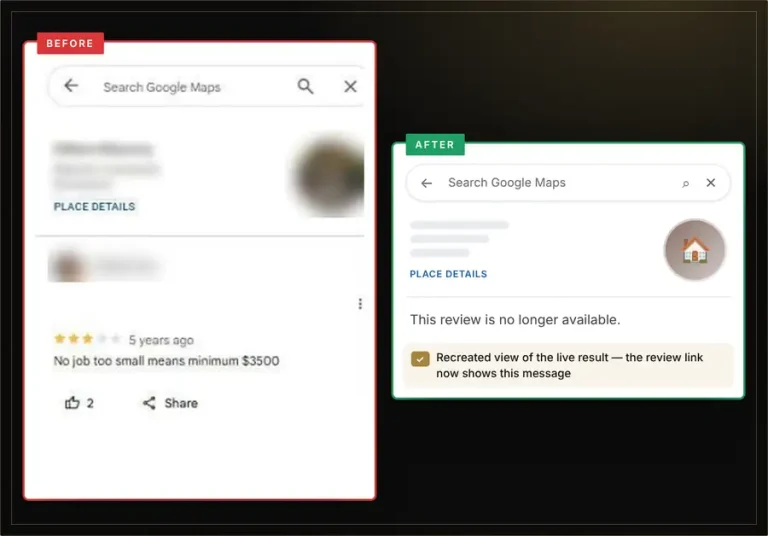
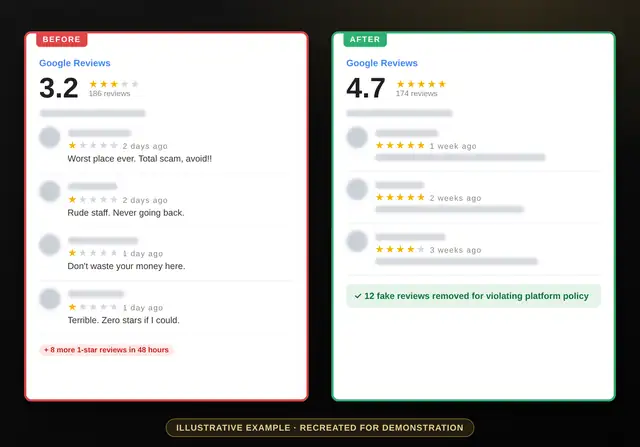
More results in our review removal case studies.
Why Businesses Choose Us for Defamatory Review Removal
Not access, not influence — preparation. Every review is handled by a specialist, evidence first.
Free assessment first
We read the review, the reviewer’s history and the pattern on your profile, then tell you which route applies.
Evidence file built first
Records statements, profile forensics and timing evidence — assembled before anything is submitted.
Your one appeal protected
Google allows one appeal per review. We never spend it on a weak first draft.
Removed in 96 hours
Most Google reviews are removed within 96 hours (excluding weekends), with updates throughout.
100% money-back guarantee
If we take your order and cannot remove the review, you receive a full refund.
Nothing that risks your profile
We never create accounts, post or buy reviews, or file legal notices in your name.
Defamatory Google Reviews: Your Questions Answered
Can Google remove a defamatory review?
Yes. Google removes reviews that break its content policy, and it accepts legal removal requests for content that is unlawful, including defamation. Many defamatory reviews also break policy rules — fake engagement, conflict of interest or misinformation — which is the faster route and removes the review worldwide.
What makes a Google review defamatory?
A review is potentially defamatory when it states something false as a fact, identifies your business or a person, and causes real harm. “They stole from me” or “this clinic uses fake doctors” are statements of fact; “worst service ever” is opinion and usually is not defamatory.
Do I need to sue to remove a defamatory Google review?
Usually not. Most defamatory reviews can be removed through Google’s policy process or its legal removal request, without going to court. A court order is the last resort when the author is known and refuses to stop.
How long does defamatory review removal take?
Policy-based removals are often completed within 96 hours. Legal requests to Google can take several weeks, and court action takes months.
Will a legal removal remove the review everywhere?
Not always. Google often limits legal removals to the country where the law applies. A policy removal, when available, removes the review for everyone, which is why we try that route first.
Can I find out who wrote an anonymous defamatory review?
Google does not reveal reviewer identities without a court order. You do not need to know who wrote a review for us to remove it.
Should I reply to a defamatory review?
Keep any reply short, calm and factual — for example that you have no record of the reviewer and invite them to contact you. Do not repeat the allegation, threaten the reviewer or share private details.
What if the review is true but harsh?
Honest negative opinions from real customers are protected and are not defamatory. We tell you honestly after the free check if a review does not qualify — and you pay nothing.
Can I sue Google over a defamatory review?
Usually not. In the US, Section 230 protects Google from liability for reviews posted by users, and in the UK website operators have a defence under the Defamation Act 2013. Claims are made against the reviewer, while Google removes the review under its own policies or legal process.
What if a review accuses my business of a crime?
A false accusation of a crime, such as theft or fraud, is one of the clearest forms of defamation. Screenshot it, gather proof that the claim is untrue and report it promptly. These reviews are often among the quickest to remove.
How long do I have to take action over a defamatory review?
In England and Wales the limit is one year from publication. In the US it is usually one to three years depending on the state. Removal through Google’s own processes has no deadline, but acting quickly limits the damage.
Can I be sued for reporting a review to Google?
No. Reporting a review to Google is not unlawful. What can backfire is threatening or suing a reviewer over an honest opinion, especially in US states with anti-SLAPP laws.
What if the reviewer posts the same defamatory claim again?
Keep the earlier evidence and report the new review straight away. A repeated false claim after removal strengthens the case and can support legal action if it continues.
What qualifies as a defamatory Google review?
A defamatory Google review makes a false statement of fact that damages your reputation. To qualify as defamation, the review must state something false as though it were true — not just a harsh opinion. For example, “This company stole my money” (when no theft occurred) is defamatory; “I didn’t like their service” is not. Google’s own policies also prohibit reviews that are fake, misleading, or contain false information. Either pathway — Google’s policy violation process or a legal defamation claim — can lead to a defamatory review being removed permanently.
Can Google actually remove a defamatory review?
Yes. Google’s content policy prohibits reviews that contain misinformation — defined as content that contradicts authoritative sources or is demonstrably false. When a review makes provably false statements of fact, it can be flagged and removed through Google’s review removal process. Professional removal services know how to document the defamatory nature of a review in a way that meets Google’s internal review criteria, significantly improving approval rates compared to flagging it yourself.
How long does it take to remove a defamatory Google review?
Timelines vary depending on the review’s severity and the removal pathway used. Google typically responds to policy-violation flags within 3–10 business days. If the review is escalated through a legal channel — such as a defamation notice or court order — Google may act faster, often within 7–14 days of receiving valid documentation. Professional review removal services with established escalation processes can often achieve faster outcomes than self-service flagging.
What if Google refuses to remove a defamatory review?
If an initial flag is denied, you have several options. First, you can appeal Google’s decision with additional evidence — screenshots, records, or legal documentation proving the review is false. Second, if the reviewer can be identified, a solicitor’s letter or legal defamation notice often prompts the reviewer to delete it voluntarily. Third, for particularly damaging defamatory reviews, a court order compelling Google to remove the content is legally available in most jurisdictions. A professional removal service can advise which pathway gives the best chance of success for your specific situation.
Is it worth taking legal action over a defamatory Google review?
It depends on the harm caused and the strength of your evidence. Legal action is most cost-effective when the review is clearly false and provable, when it’s causing measurable financial damage (lost customers or contracts), and when the reviewer’s identity is known. In many cases, a formal legal notice is enough to have the review removed without ever reaching court. For businesses where online reputation directly drives revenue — hospitality, medical, legal, professional services — the return on investment from removing a defamatory review can be substantial.
How is a defamatory review different from a fake review?
A fake review is posted by someone who was never a customer — it fabricates an experience entirely. A defamatory review may be from a real customer but contains false statements of fact, such as fabricated accusations of fraud, theft, or illegal behaviour. Both can be removed, but the process differs slightly: fake reviews are flagged under Google’s spam/fake review policy, while defamatory reviews may also be actionable under defamation law. Professional removal services handle both types but will advise which policy violation is most applicable to your review.
Removed in 96 Hours — or Your Money Back
Fixed price per review. No contract, no monthly fees, no Google login. If your Google review is not removed, you receive a full refund.