Legal · Privacy
GDPR Right to Erasure and Google Reviews: Can EU and UK Privacy Law Remove Them? (2026-2027)
The GDPR gives people a “right to be forgotten”. But does it let you remove a Google review? Sometimes — when the review contains personal data about a named person. This guide explains when Article 17 applies, the strongest privacy angles, and how to file a request that Google takes seriously.
Key takeaways
- Article 17 of the GDPR (and the UK GDPR) gives individuals a right to have personal data erased in certain cases.
- It protects people, not companies. A review about a limited company is not personal data — a review naming a member of staff or a sole trader can be.
- The right is not absolute: freedom of expression is a key exception, so honest opinions about a service usually stay.
- The strongest GDPR cases involve named staff, health or other sensitive data, and inaccurate personal claims.
- Controllers normally have one month to respond to a request. If refused, you can complain to your data protection authority, such as the UK ICO.
In this guide
Can GDPR Remove a Google Review?
Sometimes. The GDPR’s right to erasure can be used to remove a Google review when the review contains personal data about an identifiable person — for example a staff member named and criticised, or private details shared without consent — and there is no overriding reason to keep it. It cannot remove a review simply because a business dislikes it, and it does not protect companies themselves. For reviews that also break Google’s policies or are defamatory, other routes are usually faster. See our legal Google review removal service.
What Article 17 Actually Says
Article 17 of the General Data Protection Regulation — and the near-identical UK GDPR — lets a person ask for their personal data to be erased “without undue delay” where, among other grounds:
- the data is no longer necessary for the purpose it was collected for;
- the person objects to the processing and there are no overriding legitimate grounds;
- the data has been processed unlawfully.
But Article 17(3) lists exceptions, and the first is the right of freedom of expression and information. A customer’s honest review of a service is a classic example of expression, which is why GDPR is a precise tool rather than a general review-removal button. The European Court of Justice confirmed the “right to be forgotten” against search engines in Google Spain (2014), but courts always balance it against public interest.
When GDPR Applies to a Google Review
| Situation | Personal data? | GDPR route realistic? |
|---|---|---|
| Review criticises “ABC Dental Ltd” | No — a company is not a person | No |
| Review names and attacks a receptionist | Yes | Often |
| Review about a sole trader by name | Yes | Sometimes — balanced against free expression |
| Review reveals someone’s health condition | Yes — special category data | Strong |
| Review shares a phone number or home address | Yes | Strong — also breaks Google policy |
| Honest opinion with no names | No | No |
Want a review gone without the guesswork?
Send us the link for a free check. We tell you within hours whether it can be removed — you only pay once we confirm.
The Strongest GDPR Angles for Review Removal
1A staff member named without consent
Reviews that name an employee and make personal attacks (“Sarah on reception is rude and incompetent”) process that employee’s personal data. The employee — not the business — can request erasure. Google also removes many such reviews under its harassment and personal information policies.
2Sensitive or private information
Health details, addresses, phone numbers or other private information about an identifiable person carry extra protection. This can include a reviewer accidentally disclosing a third person’s health information, or information about a patient.
3Inaccurate personal claims about an owner
Where a review makes false factual claims about a named owner or sole trader, the GDPR right to rectification and erasure can support a request — often alongside a defamation argument. See when a review becomes a legal case.
Why Most DIY GDPR Requests Fail
- The review is about a company. GDPR protects people, not businesses.
- The wrong person asks. The data subject (the named person) should make the request, or authorise someone to act for them.
- No specific data is identified. Requests need to point to the exact personal data and explain the harm.
- Free expression wins. Honest opinions about a service, without private details, are usually kept.
- Wrong channel. Using the in-app flag instead of Google’s legal removal process.
How to File a GDPR Removal Request With Google
- Identify the personal data — the name, details or claims about an identifiable person.
- Confirm who the data subject is and get their written authority if you are acting for them.
- Report the review in Google first for harassment or personal information, which is often enough.
- Use Google’s legal removal process — report content for legal reasons — and choose the privacy or data protection option.
- Give the exact URL of the review and explain which data is involved and why erasure is justified.
- Keep the reference number and allow up to one month for a response.
- Escalate if refused by complaining to your data protection authority, such as the UK Information Commissioner’s Office.
Tip: GDPR requests work best for one clear problem — a named person, private data or false personal claims. For fake, off-topic or competitor reviews, Google’s own policies are faster. Our policy violations checklist helps you choose.
GDPR vs Google’s Own Review Policies
| Google policy report | GDPR request | Defamation claim | |
|---|---|---|---|
| Covers | Fake, off-topic, harassment, conflict of interest, personal info | Personal data about identifiable people | False statements causing serious harm |
| Who can use it | Business owner or anyone | The person whose data it is | The person or company defamed |
| Typical time | Days to weeks | Up to one month for a response | Weeks to months |
| Cost | Free | Free, unless you use a lawyer | Legal fees likely |
Learn more in removing bad Google reviews legally in the UK and can you sue for a fake Google review?
What If You Are Outside the UK and EU?
The GDPR applies to people in the EU and UK, and to organisations offering services to them. Businesses in other countries can still use Google’s own content policies, local privacy laws and defamation law. In the US, there is no general right to erasure for reviews, so policy reports and defamation routes are the main options.
What Review Removal Looks Like
Before-and-after results from ReviewsEraser clients.
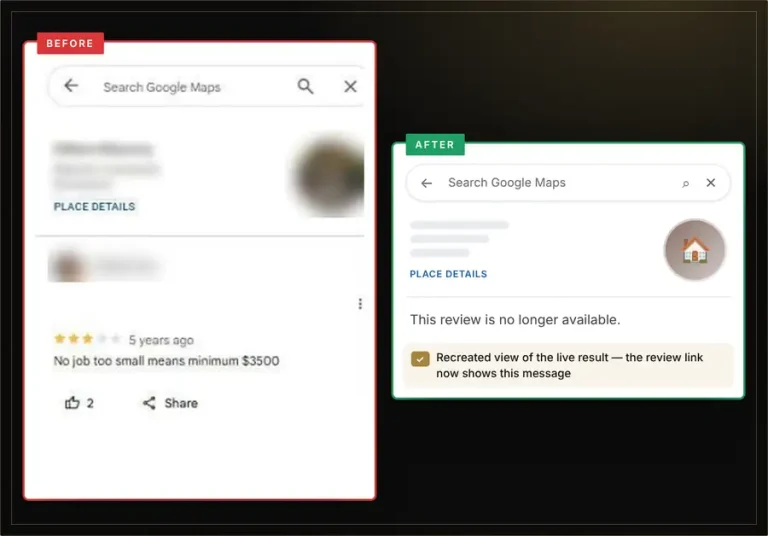
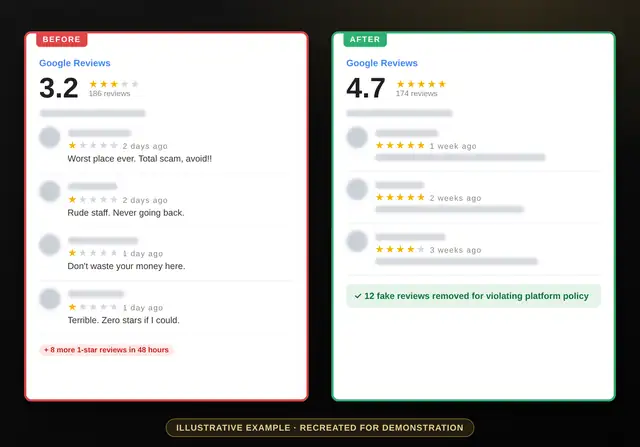
See more results in our review removal case studies.
Important: this guide is general information, not legal advice. For a specific dispute, speak to a qualified solicitor or attorney. ReviewsEraser never files legal notices in your name without your approval.
GDPR and Google Reviews: Frequently Asked Questions
Can I use GDPR to remove a negative Google review about my business?
Only if the review contains personal data about an identifiable person, such as a named staff member or sole trader, and erasure outweighs free expression. Reviews about a company alone are not covered.
Does GDPR protect companies?
No. GDPR protects living individuals. Limited companies must use Google’s policies or defamation law instead.
Who should make the GDPR request?
The person whose personal data appears in the review, or someone they have authorised in writing.
How long does Google have to respond?
Under the GDPR, controllers normally have one month to respond, which can be extended in complex cases.
What if Google refuses my request?
You can complain to your data protection authority, such as the UK ICO, or consider other routes like defamation.
Does the UK still follow GDPR after Brexit?
Yes. The UK GDPR and Data Protection Act 2018 keep almost identical rights, including the right to erasure.
Can a reviewer’s own name be removed?
The reviewer can delete their own review at any time. Businesses cannot remove a review simply because it shows the reviewer’s name.
Need a review removed the legal way?
We handle policy, privacy and defamation routes for Google reviews. Fixed price per review and a full refund if a review is not removed.