Legal · Defamation
Google Review Defamation: When Does a Bad Review Become a Legal Case? (2026-2027)
A harsh review is not automatically defamation. This guide explains, for UK and US businesses, the legal test a review must meet, which statements usually cross the line, the risks of suing (including anti-SLAPP laws), how to identify an anonymous reviewer, and the cheaper routes most cases should try first.
Key takeaways
- Defamation requires a false statement of fact, not opinion, that harms your reputation.
- In England and Wales, a business must show serious financial loss under the Defamation Act 2013.
- In the US, Section 230 generally protects Google itself, so claims are against the reviewer.
- Many US states have anti-SLAPP laws that can make a business pay the reviewer’s legal costs if a weak claim fails.
- Google’s legal removal form can remove defamatory reviews without going to court.
In this guide
When Is a Google Review Defamatory?
A Google review is defamatory when it states something false as fact, is published to others, and causes (or is likely to cause) real harm to your reputation. “The worst meal I’ve had” is opinion. “They served me out-of-date chicken and the owner is a convicted fraudster” — if untrue — is a factual claim that may be defamatory. In England and Wales, a business must also show serious financial loss. Most defamatory reviews can be removed through Google’s legal removal process without a lawsuit — see our defamatory Google review removal service.
Fact vs Opinion: The Line That Decides Everything
| Statement | Fact or opinion? | Potentially defamatory? |
|---|---|---|
| “Rude staff, wouldn’t go back.” | Opinion | No |
| “Overpriced for what you get.” | Opinion | No |
| “They charged my card twice and refused a refund.” | Fact | Yes, if false |
| “The dentist is not qualified.” | Fact | Yes, if false |
| “The owner is a thief.” | Fact (accusation of crime) | Yes, if false |
| “I think they’re a scam.” | Depends on context | Possibly, if it implies false facts |
The Legal Elements of Defamation
1England and Wales
The statement must refer to you, be published to a third party, and have caused or be likely to cause serious harm. For a body trading for profit, harm is not “serious” unless it causes or is likely to cause serious financial loss (Defamation Act 2013, section 1). Defences include truth, honest opinion and public interest. Claims generally must be brought within one year of publication.
2United States
Typically you must show a false statement of fact, published to others, made with at least negligence (or “actual malice” for public figures), causing damages. Under Section 230 of the Communications Decency Act, platforms such as Google are generally not liable for users’ reviews, so claims are brought against the reviewer. Time limits are often one to two years, depending on the state.
3Other countries
Australia, Canada, India and the EU each have their own rules. A local lawyer should advise before any action. See our review removal by country guides.
Want a review gone without the guesswork?
Send us the link for a free check. We tell you within hours whether it can be removed — you only pay once we confirm.
Review Statements That Commonly Cross the Line
- False accusations of crime: theft, fraud, assault.
- False claims about health and safety: food poisoning, unhygienic premises, unlicensed treatment.
- False claims about qualifications or licences.
- Invented events: a transaction, an incident or a conversation that never happened.
- False claims of discrimination or illegal practices.
Statements That Usually Are Not Defamatory
- Opinions and value judgements: “terrible”, “rude”, “not worth it”.
- Exaggeration no one would read literally: “waited a century for my food”.
- True statements, even if damaging.
- Fair comment on facts that are true and stated.
These can still sometimes be removed if they break a Google policy — check our policy violations checklist.
The Risks of Suing Over a Google Review
- Cost: defamation litigation is expensive, and costs can exceed any damages.
- Anti-SLAPP laws: many US states, such as California and Texas, let reviewers ask for early dismissal and can require the business to pay the reviewer’s legal fees if the claim fails.
- The Streisand effect: a lawsuit can draw far more attention to the review than the review itself.
- Proof burden: you must prove falsity and harm with evidence.
- Time: court cases take months or years; the review stays up meanwhile unless removed another way.
What If the Reviewer Is Anonymous?
Google does not reveal reviewers’ identities on request. In the UK, a court can grant a Norwich Pharmacal order requiring a platform to disclose identifying information. In the US, a business can file a “John Doe” lawsuit and seek a subpoena. Both require legal advice and evidence that the review is likely unlawful.
What to Do About a Defamatory Review — In Order
- Capture evidence: screenshots with dates, URLs and the reviewer profile.
- Report the review under the closest Google policy — many defamatory reviews are also fake or conflict-of-interest.
- File a legal removal request with Google, quoting the false statements and your evidence.
- Reply calmly in public with the facts — see our reply templates.
- Consider a solicitor’s letter if you know who the reviewer is.
- Litigation as a last resort, with legal advice.
UK owners should also read removing bad Google reviews legally in the UK; for suing specifically, see can you sue for a fake Google review?
Disclaimer: this article is general information, not legal advice. Laws differ by country and state. Speak to a qualified lawyer before taking legal action.
What Review Removal Looks Like
Before-and-after results from ReviewsEraser clients.
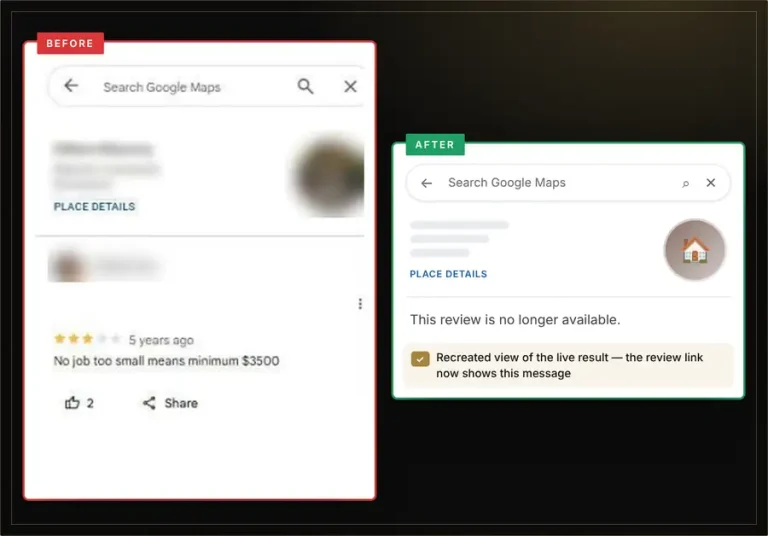
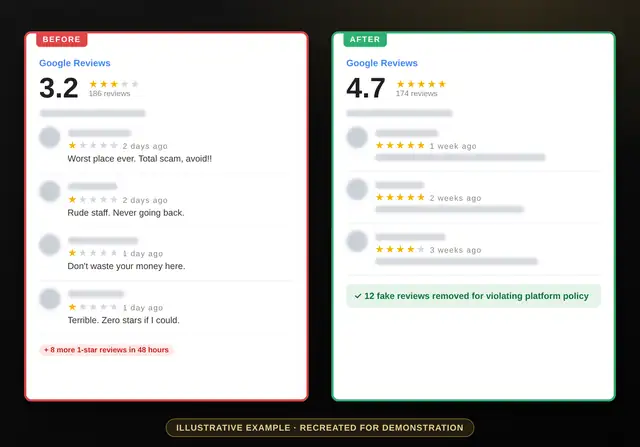
See more results in our review removal case studies.
Google Review Defamation: FAQs
Is a negative Google review defamation?
Only if it contains false statements of fact that harm your reputation. Negative opinions are not defamation.
Can I sue Google for a defamatory review?
In the US, Section 230 generally protects Google. In the UK, Google can rely on defences if it acts on a valid notice. Claims are usually against the reviewer.
How do I prove a review is defamatory?
Show the statement is factual, false and refers to you, and provide evidence of harm such as lost business.
How long do I have to take action?
In England and Wales, generally one year from publication. In the US it varies by state, often one to two years.
Will Google remove a defamatory review without a court order?
Often yes, through its legal removal process, if the request is clear and supported.
Can ReviewsEraser help without a lawsuit?
Yes. We prepare policy and legal removal requests, usually removing reviews within 96 hours, with a full refund if a review is not removed.
A false review hurting your business?
Most defamatory reviews can be removed without court. Get a free assessment and fixed quote.