Airbnb Hosts
Airbnb Superhost Status: How Many Bad Reviews Will Cost You the Badge?
The rating math behind the Superhost badge, how many bad reviews your listing can absorb, and which Airbnb reviews can actually be removed.
You open your Airbnb dashboard on a random Tuesday and there it is: a fresh 1-star review from a guest who complained about street noise you have zero control over. Your stomach drops. Is that it? Is Superhost gone — just like that, over one bad night?
What actually decides how much damage that one review does is how many total reviews you already have. A host with 10 reviews can be knocked out of Superhost by a single bad guest. A host with 40+ reviews can absorb the exact same review and barely feel a thing. Below is the math, worked out review by review, so you can see exactly where your own listing stands — and whether you should be worried at all.
There is no fixed number of bad reviews that costs you Superhost. Airbnb checks your overall rating (4.8+), response rate (90%+), cancellation rate (under 1%) and completed stays every quarter, over the past 365 days. How much one bad review hurts depends on how many reviews you already have.
📌 Key takeaways
- Superhost requires a 4.8+ average rating, a 90%+ response rate, under 1% cancellations, and 10+ completed stays (or 3+ reservations totaling 100+ nights) — all measured over the trailing 365 days.
- Status is re-evaluated quarterly (Jan 1, Apr 1, Jul 1, Oct 1). A rating that dips below 4.8 on evaluation day costs you the badge for that quarter.
- With 38 or more existing 5-star reviews, one new 1-star review still keeps your average at 4.8 or above.
- With fewer than 38 reviews, one 1-star review can drop you below the line — and the fewer reviews you have, the harder it hits.
- The “Guest Favorite” badge is a separate, algorithmic ranking — not a fixed cutoff — and typically sits closer to a 4.9+ average among top-ranked listings.
🧭 In this guide
- Superhost requirements
- How many bad reviews you can absorb
- How one 1-star review moves your rating
- The two breakeven numbers
- Superhost vs. Guest Favorite
- How Airbnb reviews and timing work
- When a bad review is worth fighting
- Which Airbnb reviews can be removed
- 7 ways to protect your status
- Removal vs. diluting with new reviews
- Frequently asked questions
- How ReviewsEraser Can Help
Airbnb Superhost Status Requirements: The Rules You’re Measured Against
Airbnb has never published a “reviews allowed” quota, and hosts who go looking for one usually come away more confused, not less. That’s because Superhost isn’t a review-counting system at all — it’s a rolling average measured against four thresholds, all evaluated on the same trailing 12-month window:
| Requirement | Threshold |
|---|---|
| Overall rating | 4.8 or higher |
| Response rate | 90% or higher |
| Cancellation rate | Below 1% |
| Completed stays | 10+ stays, or 3+ reservations totaling 100+ nights |
| Measurement window | Trailing 365 days, re-checked every quarter |
The rating threshold is the one that blindsides hosts, because it’s a moving average, not a snapshot in time. Every single new review recalculates your entire 365-day figure, instantly. A 4.79 misses the badge exactly the same way a 3.9 does — Airbnb’s system draws a hard line, not a sliding scale of sympathy.
How Many Bad Reviews Can Your Airbnb Superhost Status Survive? It Depends on Volume
Here’s the mechanic almost every “how many bad reviews” article conveniently skips: your star rating is an average, and averages get harder to move the bigger the sample gets. That’s it. That’s the whole secret. The formula is simple:
New average = (Current average × Number of reviews + New rating) ÷ (Number of reviews + 1)
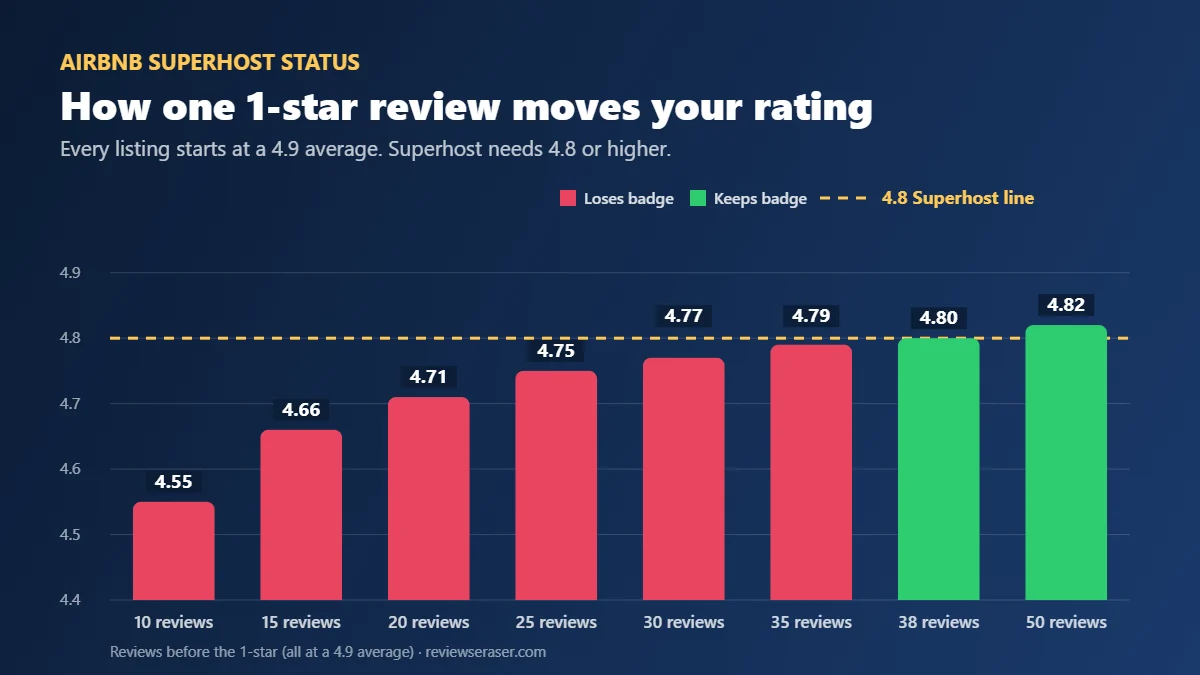
Run that formula against a listing with only 10 reviews sitting at a 4.9 average, and one single 1-star review drags it all the way down to 4.55 — miles below the Superhost line. Now run the identical 1-star review against a listing with 40 reviews at that same 4.9 average, and the damage barely registers: it lands at 4.80, right on the threshold, badge intact. Same review. Same disgruntled guest. Wildly different consequences — purely because of sample size.
This is why two hosts can receive the exact same complaint, word for word, and end up in completely different places three months later. It isn’t luck, and it isn’t favoritism from Airbnb. It’s arithmetic.
Rating Math: How One 1-Star Review Affects Airbnb Superhost Status by Listing Size
The table below starts every listing at a 4.9 average — a realistic, strong starting point for an established host — then drops in a single 1-star review and shows exactly where the new average lands, plus how many fresh 5-star reviews it takes to climb back to 4.8 or above.
| Reviews before (at 4.9 avg) | New average after one 1★ | 5★ reviews needed to recover to ≥4.8 |
|---|---|---|
| 10 | 4.55 | 14 |
| 15 | 4.66 | 12 |
| 20 | 4.71 | 9 |
| 25 | 4.75 | 7 |
| 30 | 4.77 | 4 |
| 35 | 4.79 | 2 |
| 38+ | 4.80+ | 0 — stays Superhost-eligible |
Note: Airbnb’s actual algorithm may weight recency and other factors beyond a simple mean, and rounding conventions can shift results slightly. These figures use the straightforward average method and are meant to show the shape of the problem, not a guaranteed platform calculation.
The Two Breakeven Numbers Every Host Should Know
Run the same math from a perfect 5.0 starting average instead of 4.9, and you get a second, even cleaner benchmark — the number worth pinning above your desk:
- Starting from a 4.9 average, you need 38 or more existing reviews before a single 1-star review stops being able to drag you below the 4.8 Superhost line.
- Starting from a perfect 5.0 average, you need 19 or more existing reviews to reach that same safety margin.
If your listing is newer or smaller than that, this isn’t a verdict on your hosting — it’s a statistical fact of small numbers, full stop. Every single review carries more weight than it ever will again once your listing matures. That’s exactly why one unfair, fake, or policy-violating review is worth fighting hard when you’re under those thresholds, and why removal — not just diluting it with new reviews and hoping — is so often the faster, smarter fix.
Airbnb Superhost Status vs. Guest Favorite: Two Different Bars
Hosts constantly conflate two separate badges with two completely separate rulebooks:
Superhost is a fixed threshold. Hit 4.8+ rating, 90%+ response rate, under 1% cancellations, and the activity minimum, and you qualify — full stop, no ranking against other hosts involved.
Guest Favorite plays by different rules entirely. It isn’t a number you can hit once and lock in forever. Airbnb assigns it using a blended, algorithmic score built from rating, review volume and recency, host reliability, and low guest-complaint rates — essentially a moving percentile ranking against comparable listings, re-evaluated continuously. Publicly available data on badged listings suggests average ratings closer to 4.9–4.95 among Guest Favorites, comfortably above the Superhost floor, though Airbnb has never published an exact cutoff. Treat “stay above 4.8” as your safe target for Superhost, and think of Guest Favorite as the reward for consistently blowing past that bar — not a separate number to chase directly.
Want a review gone without the guesswork?
Send us the link for a free check. We tell you within hours whether it can be removed — you only pay once we confirm.
How Airbnb Reviews Work — and Why Timing Matters for Superhost Status
Before you can protect your Airbnb Superhost status, it helps to know exactly how a review reaches your rating:
- 14-day review window. Guests and hosts have 14 days after checkout to write a review. Reviews are double-blind: neither side sees the other’s review until both are submitted or the window closes.
- Overall rating plus six categories. Guests rate cleanliness, accuracy, check-in, communication, location and value — but the Superhost rating threshold uses the overall star rating.
- Trailing 365 days. Only reviews from the past year count toward Airbnb Superhost status, so an old bad review eventually stops counting — but it can cost you several quarterly checks first.
- Quarterly evaluation. Airbnb checks Superhost status on January 1, April 1, July 1 and October 1. A bad review that lands just before an evaluation date does the most damage.
That timing is why the weeks before an evaluation date matter so much. If a policy-breaking review lands close to a quarterly check, getting it removed before evaluation day is the difference between keeping and losing your Airbnb Superhost status for the next three months.
When a Bad Review Is Worth Fighting vs. When to Let the Math Work For You
Not every low-star review deserves the same fight. Before you dive in to dispute, respond, or simply out-review it, run it through this filter:
- Fight it (dispute or request removal): the reviewer never actually stayed at your listing, the review targets something entirely outside your control (noise, a neighbor, the building, weather, a third-party service), it contains discriminatory or abusive language, it’s from a guest who broke your house rules and is now retaliating, or it makes clearly false factual claims you can document.
- Respond publicly, then let the math work: the review is a genuine guest’s honest opinion, even if it stings — a preference for a firmer mattress, a gripe about check-in timing, a one-off maintenance issue you’ve since fixed. These almost never qualify for removal, and fighting them can draw more eyes to the review than simply leaving it alone.
- Do both: when a review mixes a legitimate complaint with an outright policy violation (harassment buried in the wording of an otherwise fair critique, say), request removal of the violating language while responding professionally to the substance.
The instinct to argue with every bad review is almost always the wrong one — Airbnb rarely removes a review simply because a host disagrees with it. The reviews worth spending your energy on are the ones that break Airbnb’s actual content policy, not the ones that just sting to read.
Which Airbnb Reviews Can Be Removed?
Airbnb removes reviews that break its Reviews Policy — not reviews that are simply negative. These are the grounds that actually work, and how often they succeed when properly documented:
| Removal ground | What it looks like | Chance if documented |
|---|---|---|
| Retaliatory or biased review | A guest broke house rules, you reported them or filed a claim, and the review reads as payback | High |
| Coercion or extortion | The guest demanded a refund, discount or favour in exchange for a good review, or threatened a bad one | High |
| Irrelevant content | The review is about Airbnb support, the booking process, someone else’s stay or a cancelled trip | High |
| Content policy violation | Discrimination, hate speech, threats, explicit content or private personal information | High |
| Outside the host’s control | Complaints about weather, construction or neighbourhood events the listing never promised | Medium — judged case by case |
| Honest negative opinion | A real guest’s fair account of their stay | Low — respond instead |
Report each review once, with evidence. Airbnb limits how many times a review can be reported, and hosts with unusually high removal-request rates can put their own Airbnb Superhost status at risk.
7 Ways to Protect Your Airbnb Superhost Status
- Know your number. Count your reviews from the past 365 days and work out your breakeven using the table above.
- Watch the calendar. Track the next quarterly evaluation date and treat any bad review in the six weeks before it as urgent.
- Prevent surprises. Fix common complaint triggers — check-in instructions, cleanliness, accurate photos — before they become reviews.
- Document problem stays. Save messages, photos and house-rule breaches while the stay is happening, not after the review lands.
- Report only what breaks the rules. One well-evidenced report beats several weak ones.
- Respond calmly to honest reviews. A short, factual reply reassures future guests without starting an argument.
- Keep response and cancellation rates safe. A 90%+ response rate and under 1% cancellations matter just as much as the 4.8 rating for Airbnb Superhost status.
Fast Path vs. Slow Path: Removal vs. Diluting With New Reviews
Once you’ve confirmed a review is policy-violating, you have two ways to protect your rating — and they run on wildly different clocks.
The slow path — collecting new reviews. Using the table above, a host with 10 existing reviews needs 14 new 5-star stays to fully recover from a single 1-star hit. At realistic booking and review-response rates, that can eat up months, and every day in between is a day your rating sits below the Superhost line, visible to every single guest sizing up your listing.
The fast path — permanent removal. If the review breaks Airbnb’s content policy — fake, extortion, discriminatory, harassment, unrelated to the actual stay, or from someone who was never a guest — it can be removed outright instead of diluted. That snaps your average back to exactly where it was before the review ever posted. No waiting on new bookings. No gambling on strangers leaving five stars on your timeline instead of theirs.
If you’re trying to figure out whether a specific review on your listing actually qualifies for removal, our Airbnb review removal service checks the case against Airbnb’s real policy grounds before you spend months trying to out-review the problem instead.
Not sure if your review qualifies for removal — or if the math already says you’re safe?
Airbnb Superhost Status — Frequently Asked Questions
How many bad reviews does it take to lose Airbnb Superhost status?
There’s no fixed count, and anyone who tells you an exact number is guessing. Airbnb measures your average rating over the trailing 365 days, re-checked quarterly. One bad review can cost a new host with few reviews the badge outright, while an established host with 38+ strong reviews can absorb the same review and stay comfortably above the 4.8 threshold.
What rating do I need to keep Airbnb Superhost status?
4.8 or higher, averaged across your last 365 days of reviews, alongside a 90%+ response rate, under 1% cancellations, and at least 10 completed stays (or 3+ reservations totaling 100+ nights).
How often does Airbnb check Superhost eligibility?
Quarterly — on January 1, April 1, July 1, and October 1. Each evaluation looks back across the preceding 12 months of activity, not just the current quarter.
Can one 1-star review really cost you Airbnb Superhost status?
Yes, if your total review count is low. With 10 total reviews at a 4.9 average, a single 1-star review drops you to roughly 4.55 — well below the 4.8 line. With 38 or more reviews at that same starting average, the exact same review keeps you at or above 4.8.
Does a removed review restore my original rating?
Yes. When a review is removed under Airbnb’s content policy, it’s excluded from your rating calculation entirely, snapping your average back to what it would have been without that review — rather than simply piling new reviews on top of the damage.
Is Guest Favorite the same as Superhost?
No, and treating them as interchangeable is one of the most common host mistakes. Superhost is a fixed set of thresholds. Guest Favorite is an algorithmic, relative ranking based on rating, review volume, host reliability, and complaint rates, and it isn’t tied to one published number.
Can I dispute an unfair Airbnb review myself?
Yes — Airbnb lets hosts report reviews that violate its content policy directly through the platform. Success depends heavily on matching the review to a specific policy ground rather than simply arguing it’s unfair, which almost never works on its own.
How long does it take to recover Airbnb Superhost status after losing it?
You become eligible again at the next quarterly evaluation, once your trailing-365-day metrics clear all four thresholds — which can mean waiting up to three months even after your rating has already recovered, since eligibility is only checked on those fixed evaluation dates.
Does responding to a bad review help my rating?
A public response won’t move the numerical rating, but it absolutely shapes how future guests read your listing. For reviews that don’t qualify for removal, a calm, factual response is almost always the smarter play than trying to fight an honest one.
What’s the fastest way to fix a rating that’s already below 4.8?
Start by identifying whether any of the reviews pulling your average down violate Airbnb’s content policy — those can potentially be removed outright, which moves the needle immediately. For everything else, focus on your next bookings: the fastest recovery combines removing what’s removable with actively, politely encouraging your most recent satisfied guests to leave a review.
Does Airbnb Superhost status help my listing get booked?
Superhost listings show a badge, and guests can filter search results to see only Superhosts, which can make your listing more visible and trusted. Airbnb does not publish exactly how Superhost status affects search ranking.
Can I lose Airbnb Superhost status even with a 5-star rating?
Yes. Airbnb Superhost status also requires a 90%+ response rate, a cancellation rate under 1% and enough completed stays. Missing any one of the four requirements on evaluation day costs you the badge, however good your reviews are.
Related reading: Airbnb Review Removal Service · The 4.2 vs 4.7 Rating Problem · Google Review Removal Service (homepage)
Got a Airbnb review that breaks the rules?
Send us the link for a free check. We tell you within hours whether it can be removed, and you only pay once we confirm.