Google Reviews · Research
4.2 vs 4.7 Star Rating: The Psychology Behind Customer Choices (2026-2027)
Half a star does not sound like much. But to a customer comparing three businesses on Google Maps, 4.2 and 4.7 can feel like the difference between “risky” and “safe”. Here is what the research says about star ratings, why the effect is not linear, and the maths of closing the gap.
Key takeaways
- 31% of consumers now say they will only use businesses rated 4.5 stars or higher, up from 17% a year earlier (BrightLocal, 2026).
- Research from Northwestern University’s Spiegel Research Center found purchase likelihood peaks between 4.0 and 4.7 stars — a perfect 5.0 can look too good to be true.
- Star ratings work as thresholds, not a straight line: crossing 4.5 matters more than moving from 3.8 to 4.0.
- Lifting a 50-review profile from 4.2 to 4.7 takes roughly 84 new 5-star reviews — or removing about seven unfair 1-star reviews.
- The best strategy combines removing rule-breaking reviews with a steady flow of genuine ones.
In this guide
Does a 4.2 vs 4.7 Star Rating Really Matter?
Yes — more than most owners expect. Customers use star ratings as a quick filter. Many will not even consider a business below 4.5 stars, and a 4.2 rating often signals “something might go wrong”. At the same time, research shows a perfect 5.0 can reduce trust. The sweet spot for most local businesses is around 4.5 to 4.8, with plenty of recent reviews. If unfair or fake reviews are holding you below that line, our Google review removal service can help.
What the Research Actually Says
| Finding | Source |
|---|---|
| 31% of consumers will only use businesses rated 4.5 stars or higher (up from 17%) | BrightLocal Local Consumer Review Survey, 2026 |
| 77% of consumers are put off by negative reviews | BrightLocal, 2026 |
| 74% look for reviews written in the last three months | BrightLocal, 2026 |
| Purchase likelihood peaks for ratings between 4.0 and 4.7, then declines towards 5.0 | Spiegel Research Center, Northwestern University |
| Displaying five reviews can lift conversion by 270% compared with none | Spiegel Research Center |
| High rating, review count, steady flow and recency are among the top 20 local ranking factors | Whitespark Local Search Ranking Factors, 2026 |
Sources: BrightLocal, Spiegel Research Center (summary via MarketingProfs) and Whitespark.
Why Star Ratings Work as Thresholds, Not a Straight Line
Customers do not weigh every tenth of a star equally. They sort businesses into mental buckets:
| Rating | How customers tend to see it |
|---|---|
| Below 4.0 | “Something is wrong here” — many skip it entirely |
| 4.0–4.4 | “Probably fine, but check the bad reviews first” |
| 4.5–4.8 | “Safe choice” — the zone most customers look for |
| 4.9–5.0 with few reviews | “Too good to be true?” — trust can fall |
That is why moving from 4.4 to 4.6 often changes enquiries far more than moving from 3.6 to 3.8. Google Maps also shows ratings to one decimal place, so 4.44 displays as 4.4 and 4.46 as 4.5 — small changes near a threshold can flip how you appear.
Want a review gone without the guesswork?
Send us the link for a free check. We tell you within hours whether it can be removed — you only pay once we confirm.
The Psychology Behind Star Ratings
1Negativity bias
People give more weight to negative information than positive. One vivid 1-star review can outweigh several 5-star reviews in a reader’s mind — especially if it sits at the top of your profile.
2Social proof
A high rating from many people feels safer than a high rating from a few. Review count and recency act as proof that the rating is real.
3Risk reduction
For higher-value or higher-risk purchases — a dentist, a solicitor, a builder — customers become stricter. The Spiegel research found reviews had a bigger effect on higher-priced products.
4Comparison shopping
On Google Maps, customers see three or more businesses side by side. A 4.2 next to a 4.7 looks worse than a 4.2 on its own.
The Maths of Closing the Gap
How hard is it to move from 4.2 to 4.7? It depends on how many reviews you have. For a profile with 50 reviews averaging 4.2:
| Approach | What it takes to reach 4.7 |
|---|---|
| Add new 5-star reviews only | About 84 new 5-star reviews |
| Remove unfair 1-star reviews only | About 7 reviews removed |
| Combine both | Remove 4 unfair 1-stars and add about 34 new 5-stars |
The formula is simple: every 1-star review needs several 5-star reviews to cancel it out. That is why removing fake and policy-breaking reviews is often the fastest way to cross a threshold. See how to remove 1-star Google reviews.
Which Strategy to Use
- Fewer than 30 reviews: every review matters. Remove fakes quickly and ask every customer for a review.
- 30–200 reviews: combine removal of rule-breaking reviews with a steady weekly flow of new ones.
- 200+ reviews: single reviews matter less to the average, but negative themes still shape conversions and AI summaries.
A sanity check before you start: read your last 20 negative reviews. If several mention the same genuine problem, fix it first. Removal works best for fake, unfair and outdated reviews — not for a real issue that will keep generating complaints.
Why a Few Negative Reviews Can Actually Build Trust
A wall of perfect 5-star reviews can make customers suspicious. A few genuine, mild criticisms with calm owner replies show the reviews are real and that you care. The goal is not 5.0 — it is a strong rating in the 4.5–4.8 range, built on genuine reviews, without fake or unfair ones dragging you down. Read our reply templates to turn genuine criticism into trust.
Star Ratings in AI Search
AI tools such as ChatGPT, Gemini and Google AI Overviews increasingly recommend local businesses — 45% of consumers used them for local recommendations in 2026 (BrightLocal). They look at review volume and the themes inside reviews as well as the rating. A 4.2 rating driven by fake complaints can lead to a warning in an AI answer. See AI-generated fake Google reviews.
What Review Removal Looks Like
Before-and-after results from ReviewsEraser clients.
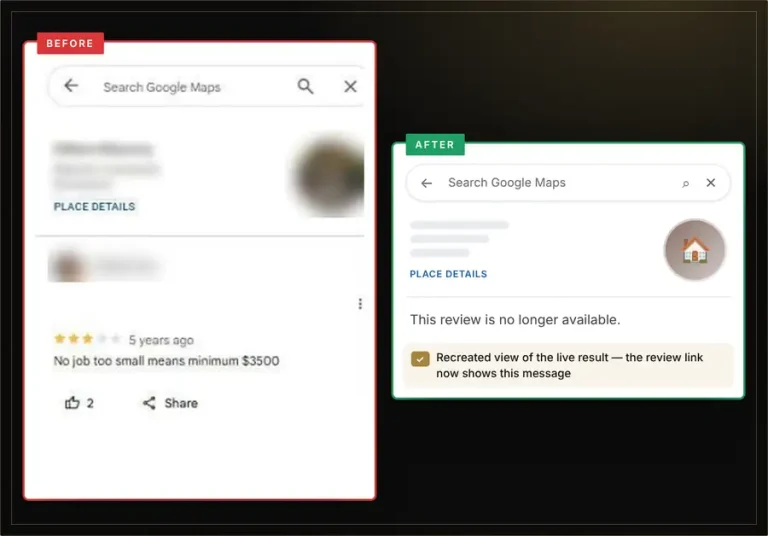
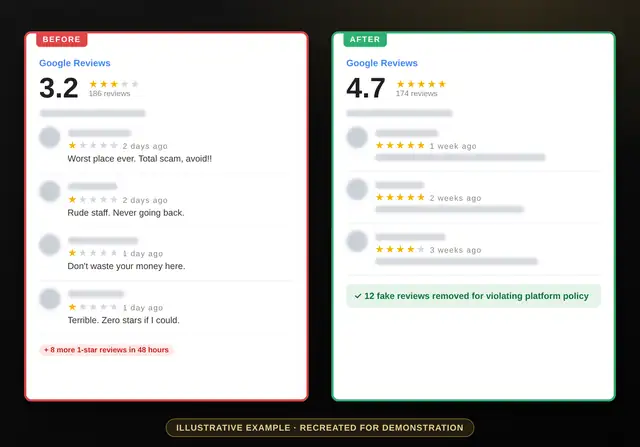
See more results in our review removal case studies.
Our promise: we never buy or incentivise reviews. We remove fake, unfair and policy-breaking reviews through legitimate routes, so your rating reflects your real customers.
Star Ratings: Frequently Asked Questions
Is 4.2 a good Google rating?
It is respectable, but many customers now look for 4.5 or higher. BrightLocal found 31% of consumers will only use businesses rated 4.5 stars or above.
Should I aim for 5.0 stars?
No. Research shows purchase likelihood peaks between 4.0 and 4.7, and a perfect 5.0 can look suspicious. Aim for a strong, genuine rating with many recent reviews.
How many 5-star reviews do I need to raise my rating?
It depends on your current count. For 50 reviews at 4.2, you would need about 84 new 5-star reviews to reach 4.7.
Does removing fake reviews make my rating look fake?
No. Removing fake and policy-breaking reviews makes your rating more accurate. What looks fake is a sudden burst of 5-star reviews.
How quickly does Google update my rating?
Usually within a day or two of a review being removed or added.
Does my star rating affect local rankings?
Yes. Whitespark’s 2026 survey lists a high rating among the top local ranking factors, alongside review count, flow and recency.
Can I remove a genuine negative review?
Google only removes reviews that break its policies, but ReviewsEraser removes any type of Google review, with a full refund if a review is not removed.
Cross the 4.5-star line faster
Unfair and fake reviews removed, usually within 96 hours. Fixed price per review and a full refund if a review is not removed.