Google Reviews · Early Detection
How to Spot Fake Google Reviews Before They Hurt Your Reputation (2026-2027)
Most owners notice fake reviews only after their rating drops. By then, customers have already read them. This guide shows you the patterns that give fake reviews away early and a simple weekly routine to catch them first.
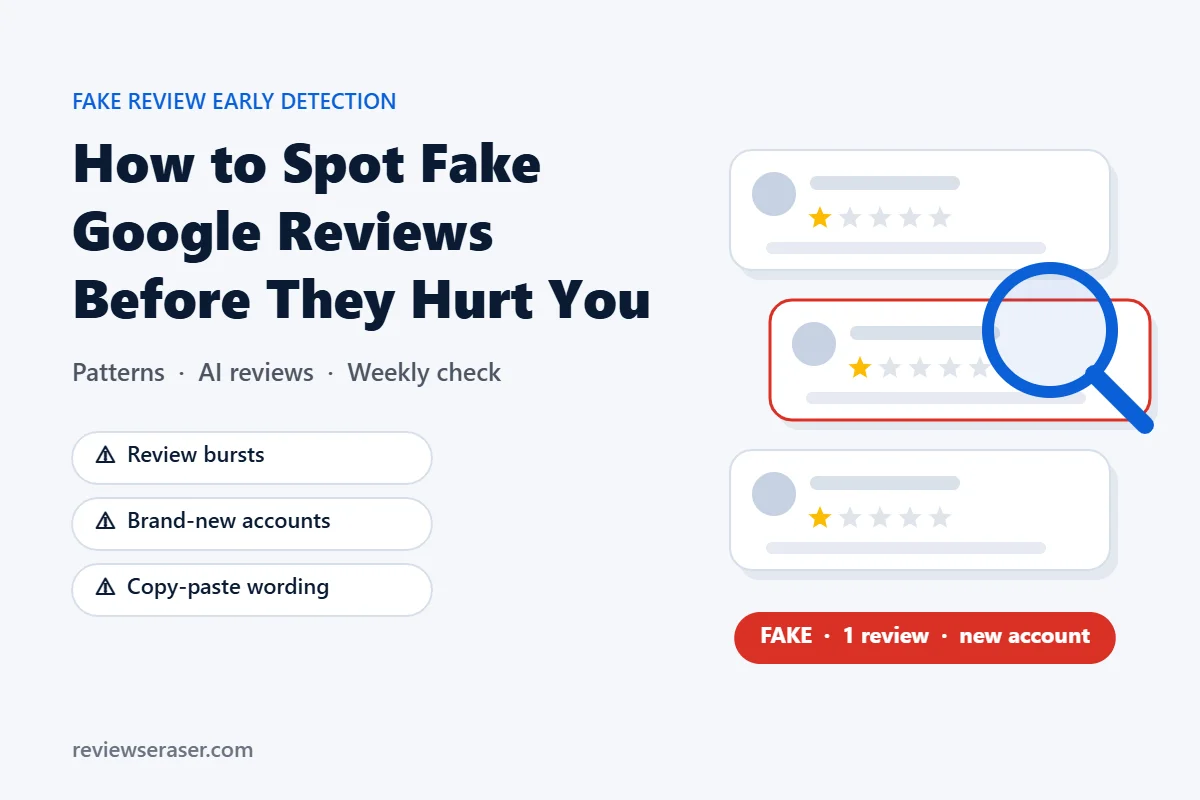
A fake one-star review does its damage in the first few days, while it sits at the top of your profile under “Newest” and drags your average down. The earlier you spot it, the less time it has to cost you customers.
Fake reviews are not rare. Google says it blocked or removed more than 292 million policy-violating reviews in 2025 alone. Most were caught automatically, but plenty still get through, and the business owner is often the first person in a position to recognise them. This guide focuses on catching fake reviews early: the patterns to watch for across your whole profile, how to check a suspicious review quickly, and a simple routine that stops attacks before they turn into a rating problem.
👉 Quick answer: To spot fake Google reviews early, turn on review notifications for your Business Profile and check every new review against your bookings or sales records within a day. Watch for patterns, not just single reviews: sudden bursts of one-star ratings, brand-new or faraway reviewer accounts, vague text with no details, repeated wording across reviews, and reviewers who also praise a competitor. When you find one, screenshot it and report it straight away under the policy it breaks.
📌 Key takeaways
- Patterns across your profile reveal fake reviews faster than any single red flag.
- Your own records are the best evidence: if a reviewer never booked, bought or visited, say so.
- Turn on review notifications and do a 15-minute check every week.
- Report fake reviews on the day you find them, with screenshots, under the exact policy they break.
- Fake positive reviews you never asked for are a risk too, and are worth reporting.
🧭 In this guide
Why Spotting Fake Reviews Early Matters
Timing changes how much a fake review can hurt you. In its first days, a new review is the first thing anyone sorting by “Newest” sees, and it pulls your star average down immediately. A business with 40 reviews averaging 4.6 stars drops to about 4.3 after just three fake one-star reviews, and that lower number is what shows next to your name in Search and Maps.
- Less exposure: a fake review reported on day one is read by far fewer customers than one found a month later.
- Fresher evidence: reviewer profiles, timing patterns and your own records are easiest to match when the review is new.
- Attacks stay small: review bombing usually starts with a few reviews. Spotting the first wave lets you report it before it grows.
- Google can act faster: Google says that when it detects a sudden spike of spam reviews, it removes them, pauses new reviews on the profile and alerts the owner. Reporting early helps it see the pattern.
The 3 Kinds of Fake Reviews That Hit Businesses
1. Attack reviews
Fake one- and two-star reviews posted to drag your rating down. They come from competitors, people with a grudge, former employees or paid review farms, and sometimes from scammers who then demand money to “remove” them.
2. Mistaken or off-target reviews
Not always malicious, but still not genuine: reviews meant for a business with a similar name, rants about something you had nothing to do with, or complaints about a product you don’t sell. They break Google’s rules on fake or off-topic content and can be reported.
3. Fake positive reviews
Five-star reviews you never asked for, often posted by spam networks to make their accounts look real. They seem harmless, but they can trigger Google’s fake-engagement checks against your profile. More on this below.
Early-Warning Signs Across Your Profile
A single odd review can be a real customer having a bad day. A pattern is much harder to explain. These are the profile-level signals that usually mean something is wrong:
| Warning sign | What it looks like | What it usually means |
|---|---|---|
| Review burst | Several one-star reviews within 24–72 hours, after weeks of quiet | Coordinated attack or review bombing |
| Brand-new accounts | Reviewers with one review ever, no photo and a generic name | Throwaway accounts created to post |
| Faraway reviewers | Accounts that review businesses in several cities or countries in one week | Paid review farm activity |
| Copy-paste wording | Different reviewers using the same phrases or structure | One person or script behind several reviews |
| Star-only reviews | A cluster of one-star ratings with no text | Fast, low-effort attack |
| Competitor praise | Reviewer slams you and gives five stars to a rival nearby | Competitor or conflict of interest |
| Off-hours timing | Reviews arriving in the middle of the night, or when you were closed | Not a real visit, or posted from abroad |
| No matching record | Name, date or order details don’t match any booking, sale or visit | Never a customer |
| Rating drop with no cause | Average falls while complaints, refunds and returns stay flat | Fake reviews, not a service problem |
Tip: one warning sign is a reason to look closer. Two or more on the same review, or the same sign across several reviews, is usually enough to report.
How to Check One Suspicious Review in 2 Minutes
When a single review looks wrong, run through these four checks before you reply or report:
- Open the reviewer’s profile. How many reviews have they written, where, and over what time span? One review ever, or dozens in different countries in one week, are both red flags.
- Search your records. Look up the name, the date and anything specific they mention in your bookings, till, CRM or emails.
- Read for specifics. Real customers mention real things: a staff member, a dish, a product, a date. Fake reviews stay vague or get basic facts wrong.
- Compare with your other recent reviews. Does the wording, timing or star rating match a cluster you’ve already seen?
For a deeper single-review checklist, see our guide on how to tell if a Google review is fake: 10 red flags.
How to Spot AI-Written Fake Reviews
AI tools now write fake reviews that read smoothly, so poor spelling is no longer a reliable clue. Look for these instead:
- Polished but empty: long, well-structured paragraphs that never name a person, product, price or date.
- Brochure language: phrases like “exceeded all expectations”, “seamless experience” or “a complete letdown from start to finish” that no customer actually says.
- Same shape, different words: several reviews that follow the same structure (praise or complaint, three reasons, closing verdict).
- Keyword stuffing: your business type and town repeated in a way that reads like an advert.
- Facts that don’t fit: services you don’t offer, opening hours you don’t keep or staff who don’t exist.
Read more in our guide to AI-generated fake Google reviews.
Build an Early-Warning System
You don’t need expensive software to catch fake reviews early. You need alerts, a habit and a record.
Turn on review notifications
Make sure email and mobile notifications for new reviews are switched on in your Business Profile settings, and that they go to someone who checks them daily. If several people manage the profile, decide who owns this job.
Keep your records easy to search
Your bookings, invoices and customer emails are the strongest proof that a reviewer was never a customer. Make sure whoever checks reviews can search them by name and date.
Keep a simple review log
A shared spreadsheet with the date, reviewer name, star rating, whether you found a matching record, and what you did. When an attack starts, this log shows the pattern at a glance and gives you evidence for an appeal.
Know your local landscape
Glance at nearby competitors’ profiles now and then. If the same accounts that hit you are leaving five-star reviews for a rival, that is valuable evidence of a conflict of interest.
The 15-Minute Weekly Review Check
Put this in the calendar for the same time every week:
- Sort reviews by “Newest” and open every review from the past seven days.
- Match each one to a booking, sale or visit, and note it in your review log.
- Open the profile of any reviewer you can’t match.
- Look for bursts: more than two negative reviews in a few days is worth a closer look.
- Compare wording across the week’s reviews for repeated phrases.
- Check your average rating against last week. If it fell, find out which reviews caused it.
- Report anything fake before you close the tab, and reply to genuine reviews.
Tip: businesses that get many reviews a day should do a quick daily check of new one- and two-star reviews, and save the full routine for the weekly slot.
Found a review that looks fake?
Send us the link for a free check. We tell you within hours whether it can be removed, and you only pay once we confirm.
What to Do the Moment You Spot a Fake Review
- Screenshot everything: the review, the reviewer’s profile and their other reviews, with the date visible.
- Identify the rule it breaks: fake engagement, conflict of interest, off-topic, harassment or personal information.
- Report it the same day from your Business Profile (Reviews › ⋮ › Report review) or through Google’s Reviews Management Tool.
- Reply calmly if you reply at all. A short, factual response (“We have no record of a visit under this name and have reported this review to Google”) protects you with readers.
- Use the right channel for threats. If anyone demands payment to stop or remove reviews, don’t pay. Use Google’s review extortion report instead.
- Track the outcome and appeal with your evidence if Google decides the review can stay.
Our full walkthrough of the reporting and appeal process is in how to remove bad reviews from Google My Business.
Fake 5-Star Reviews You Didn’t Ask For
It is tempting to leave unexpected five-star reviews alone. Don’t. Spam networks often post positive reviews on random businesses to make their accounts look genuine, and Google treats fake reviews as fake whichever way the stars point.
That matters because Google is getting stricter with businesses whose ratings look inflated. Under commitments it made to the UK’s Competition and Markets Authority in 2025, businesses found boosting their ratings with fake reviews can have a warning shown on their profile and new reviews switched off. If a burst of suspicious five-star reviews appears that you didn’t ask for, report them, and keep a note that you did.
⚖️ The rules are tightening
In the US, the FTC’s rule banning fake reviews and testimonials took effect in October 2024 and allows civil penalties for buying or selling fake reviews. In the UK, fake reviews are banned under the Digital Markets, Competition and Consumers Act 2024. Spotting and reporting fake reviews isn’t just good reputation management; it keeps your business on the right side of these rules.
6 Mistakes That Let Fake Reviews Do Damage
- Only checking when the rating drops. By then the reviews have been read for weeks.
- Judging one review in isolation. The pattern is often the strongest evidence.
- Calling a reviewer a liar in public. State the facts calmly and let the report do the work.
- Reporting without the right reason. “Fake” is not enough. Name the policy it breaks.
- Not keeping screenshots. Reviewers can edit or delete reviews, and you will need proof for an appeal.
- Fighting fake reviews with fake reviews. Posting your own positive reviews breaks Google’s rules and can get your profile restricted.
Frequently Asked Questions
How can I tell if a Google review is fake?
Check the reviewer’s profile, search your records for a matching booking or sale, and read the review for real specifics. Fake reviews often come from brand-new or faraway accounts, stay vague, repeat wording from other reviews or arrive in a sudden burst.
What is the fastest way to spot fake reviews early?
Turn on new-review notifications for your Business Profile, check every new review against your records within a day, and do a 15-minute review check every week to catch bursts and repeated wording.
How many fake reviews does Google remove?
Google says it blocked or removed more than 292 million policy-violating reviews in 2025. Most are caught automatically, but some still get through, which is why owners should check their own profiles.
Can AI-written fake reviews be detected?
Yes. Look for polished but vague text with no names, dates or products, brochure-style phrases, keyword stuffing and several reviews that follow the same structure. Facts that don’t match your business are another clue.
Is a review fake if the reviewer has only one review?
Not always. Many genuine customers review only once. Treat it as one warning sign and combine it with others, such as no matching record, vague text or timing that matches a burst of similar reviews.
Should I report fake 5-star reviews too?
Yes. Fake positive reviews break Google’s rules just like fake negative ones, and a burst of them can make your profile look manipulated. Report reviews you didn’t ask for and keep a note that you did.
What should I do if I get several fake reviews at once?
Screenshot every review and reviewer profile, report each one under the policy it breaks, and keep a log of dates. If someone demands money to stop the reviews, use Google’s review extortion report and don’t pay.
Should I reply to a review I think is fake?
You can, but keep it short and factual, for example saying you have no record of the visit and have reported it. Never accuse or insult the reviewer, and never share customer details.
🚀 Spotted a fake review on your profile?
Send us the link. We check it against Google’s policies, build the evidence and handle the removal through Google’s official channels, so you can get back to running your business.
📚 Sources
- Google: New ways we’re protecting businesses on Maps
- Google Maps: Prohibited and restricted content policy
- Google Business Profile Help: Remove reviews from your Business Profile
- Google Business Profile Help: Report negative review extortion scams
- SCL: CMA secures changes from Google to tackle fake reviews