Fake Reviews · By Source
How to Remove Fake Google Reviews by Source: Competitors, Ex-Employees, Bots and Extortionists (2026-2027)
Who wrote the fake review decides how you get it removed. A competitor’s review needs different evidence from a bot attack, and an extortion review goes through a different form altogether. This evidence-first guide breaks fake reviews down by source and gives the exact removal route for each.
Key takeaways
- Identify the likely source first: competitor, ex-employee, bot or paid campaign, extortionist, or mistaken identity.
- Each source maps to a different Google policy and evidence type.
- Conflict-of-interest reviews need proof of the relationship; bot reviews need proof of the pattern.
- Extortion has its own Google form — never pay.
- Fake reviews are banned under UK and US consumer law, which strengthens escalation.
In this guide
How Do You Remove Fake Google Reviews?
Work out who is likely behind the review, gather the evidence that proves it, and report it under the matching Google policy. Google’s content policy bans fake engagement and conflicts of interest; extortion has its own report form. If you’d rather not do it yourself, our fake Google review removal service usually removes them within 96 hours.
The 6 Sources of Fake Google Reviews at a Glance
| Source | Typical signs | Google policy | Key evidence |
|---|---|---|---|
| Competitor | Praises a rival, local profile, timed with a promotion | Conflict of interest | Link to the competitor |
| Ex-employee | Inside knowledge, posted after leaving | Conflict of interest | Employment dates |
| Bots / paid campaign | Clusters, new profiles, generic or AI text | Fake engagement | Timeline and patterns |
| Extortionist | Demand for money or freebies | Extortion | Messages and demands |
| Grudge / non-customer | Personal attack, no customer record | Fake engagement / harassment | No record; context |
| Mistaken identity | Describes another business | Off-topic | Mismatched details |
1. Fake Reviews From Competitors
Look for reviewers who also praise a rival, whose profiles show they work in your industry nearby, or whose reviews appear when a competitor launches a promotion. Report as conflict of interest and, on appeal, show the link with public information such as a business listing or professional profile. Full guide: removing competitor fake reviews.
2. Fake Reviews From Former Employees
Former staff reviewing their workplace is a conflict of interest, even if they pose as customers. Inside details, staff names and timing after a dismissal are typical. Report as conflict of interest and give employment dates in an appeal — never publish the person’s details in a reply. Employer reviews belong on sites like Glassdoor, not Google.
Want a review gone without the guesswork?
Send us the link for a free check. We tell you within hours whether it can be removed — you only pay once we confirm.
3. Bots, Click Farms and Paid Review Campaigns
Many reviews in a short time, new or empty profiles, similar wording and reviewers spread across the world point to an organised campaign. These are fake engagement. Log every review in a timeline, report each one, and contact Business Profile support with the pattern. AI tools have made the text more convincing — see AI-generated fake reviews — and the review bombing survival guide covers the hour-by-hour response.
4. Extortionists
Some scammers post 1-star reviews and then demand payment to stop, or threaten reviews unless you give refunds or free services. Don’t pay and don’t negotiate. Save the messages and use Google’s review extortion report. Google described its action against these scams on its blog. See review blackmail removal.
5. Grudges and People Who Were Never Customers
Neighbours in a dispute, ex-partners, or people angry about something you posted online sometimes leave reviews without ever being customers. Report as fake engagement (no genuine experience) or harassment if it attacks named people. If the review makes false factual claims, consider Google’s legal removal form.
6. Mistaken Identity
Not every wrong review is malicious: customers confuse businesses with similar names or nearby locations. Report it as off-topic and politely point out the mix-up in a reply. These are often among the easiest to remove.
Evidence Checklist for Any Fake Review
- Screenshot of the review and reviewer profile with dates.
- Search of your bookings, sales and CRM for the name.
- Details in the review that don’t match your business.
- Links to competitors, former employment or prior disputes.
- Timeline of related reviews.
- Any messages, demands or threats.
Then follow our 5-step fake review playbook. Fake reviews are banned in the UK under the DMCC Act 2024 (CMA guidance) and in the US under the FTC rule.
What Review Removal Looks Like
Before-and-after results from ReviewsEraser clients.
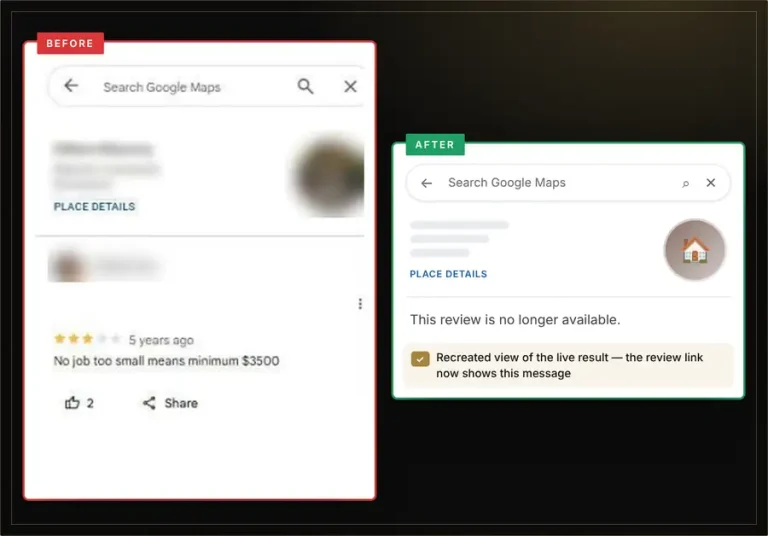
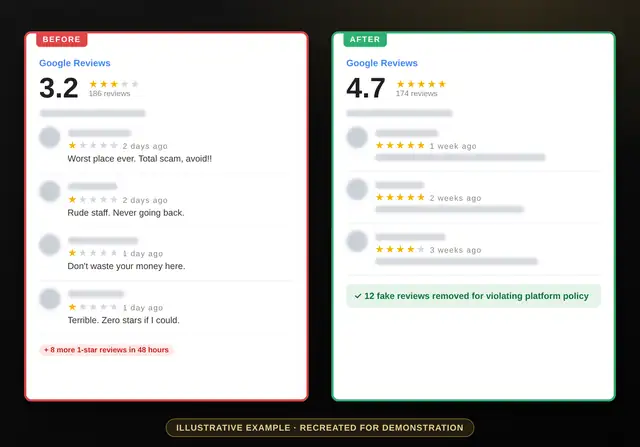
See more results in our review removal case studies.
Removing Fake Google Reviews by Source: FAQs
How can I prove a competitor wrote a fake review?
Look for public links between the reviewer and the competitor, plus no customer record. Present them in an appeal.
Can I remove a review from a former employee?
Yes. It is a conflict of interest under Google’s policy.
What should I do if someone demands money to remove reviews?
Don’t pay. Keep the evidence and use Google’s extortion report form.
How do I deal with dozens of fake reviews at once?
Log them in a timeline, report each one, contact Business Profile support with the pattern, and get professional help quickly.
Can Google tell me who wrote a fake review?
No. Identifying an anonymous reviewer usually needs a court order.
How fast can you remove fake reviews?
Usually within 96 hours, with a 100% refund if a review is not removed.
Know who’s behind it? We’ll take it down.
No login needed, never contacting reviewers, fixed price per review, 100% money-back guarantee.