Odds · Data
Google Review Removal Success Rates (2026-2027): What Really Decides Whether a Review Comes Down
You will find all sorts of “success rate” percentages online, but Google does not publish removal rates by method, so most of those numbers cannot be checked. What we can tell you is what actually moves the odds: the type of review, the route you choose and the evidence you bring. This guide ranks each method by likelihood and shows how to stack the odds in your favour.
Key takeaways
- Google does not publish success rates by removal method, so be sceptical of exact percentages.
- The biggest factor is the review itself: clear policy breaches are far more likely to be removed than unfair opinions.
- Evidence and the right report reason matter more than the number of flags.
- Appeals, legal routes and professional escalation each improve the odds for different kinds of review.
- Choose a provider that refunds you if a review is not removed, so the risk is not yours.
In this guide
What Is the Success Rate for Removing Google Reviews?
There is no single success rate. Whether a review is removed depends mostly on whether it breaks Google’s content policy or the law, and how well the case is presented. Clear violations such as spam, hate speech or personal information have a high chance of removal even with a simple flag. Fake or competitor reviews need evidence. Honest negative opinions are unlikely to be removed by any method. At ReviewsEraser, we only charge for reviews we remove — if we cannot remove a review, you get a 100% refund. See our Google review removal service.
What Google’s Own Data Tells Us
Google reports that its systems block or remove large numbers of policy-violating reviews every year, most of them before they are ever published, and it has added warnings for profiles targeted by fake reviews — see Google’s update on protecting businesses on Maps. That tells us two things: Google takes fake reviews seriously, and the reviews that reach your profile are the ones its automated checks missed. Those are exactly the cases where a better-presented report makes the difference.
Removal Likelihood by Type of Review
| Review type | Likelihood of removal | What decides it |
|---|---|---|
| Spam, links, adverts | High | Easy to verify |
| Hate speech, threats, obscene content | High | Clear policy breach |
| Personal information | High | Visible in the review text |
| Off-topic or wrong business | Medium to high | Context about your business |
| Fake reviewer | Medium | Evidence of no customer relationship and patterns |
| Competitor or ex-employee | Medium | Proof of the link |
| Defamatory claims | Medium | Proof the claims are false and harmful |
| Honest negative opinion | Very low | Protected by policy and law |
Check which category your review fits with our policy violations checklist.
Want a review gone without the guesswork?
Send us the link for a free check. We tell you within hours whether it can be removed — you only pay once we confirm.
Removal Likelihood by Method
1Single flag with a generic reason
Lowest odds for anything that is not an obvious breach. Many first reports are rejected because the reason chosen does not match the problem. See why your flag didn’t work.
2Flag with the correct reason
Better odds for clear violations. Still weak for fake reviews that look genuine.
3Appeal with evidence
Using the review management tool to appeal with records and timelines gives fake and conflict-of-interest cases a real second chance.
4Legal removal request
Strong for defamation and privacy cases that meet the legal test, through Google’s legal removal process. Read legal Google review removal.
5Solicitor or attorney letter
Can persuade a reviewer to remove a review, but is costly and can backfire if the review is honest opinion.
6Professional escalation
Combines the right policy, evidence and route for each review. It cannot remove honest opinions, but it gives eligible reviews their best chance. Compare in service vs DIY.
What Lowers Your Chances of Removal
- Choosing the wrong report reason.
- Reporting with no evidence.
- Mass-flagging from friends’ accounts.
- Replying aggressively, which can make your case look like a dispute rather than a violation.
- Offering the reviewer money or gifts to remove it.
- Waiting months, which lets the trail of evidence go cold.
What Raises Your Chances of Removal
- Matching the review to one clear policy.
- An evidence pack: no booking record, timelines, profile patterns, links to competitors — see our fake review playbook.
- Grouping linked reviews to show a campaign, as in a review bombing attack.
- Using the right channel — legal form for defamation, extortion form for blackmail.
- Acting quickly while evidence is fresh.
How to Judge Success-Rate Claims From Removal Companies
Any company can publish a percentage. Ask instead:
- What happens if my review is not removed — do I get a refund?
- Will you assess my review and tell me honestly if it is unlikely to be removed?
- Do you need my Google login? (The answer should be no.)
- Can I see case studies? Ours are on our case studies page.
Our approach: we assess every review for free. If we think it cannot be removed, we tell you. If we take it on and it is not removed, you get a full refund.
What Review Removal Looks Like
Before-and-after results from ReviewsEraser clients.
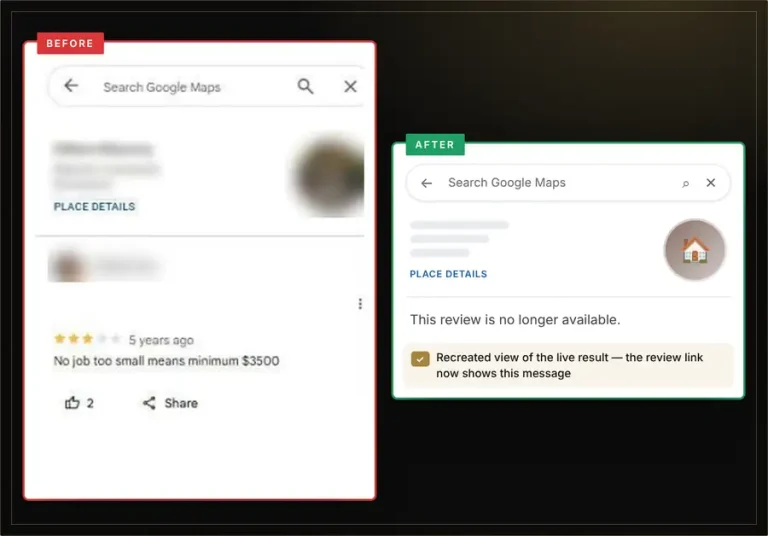
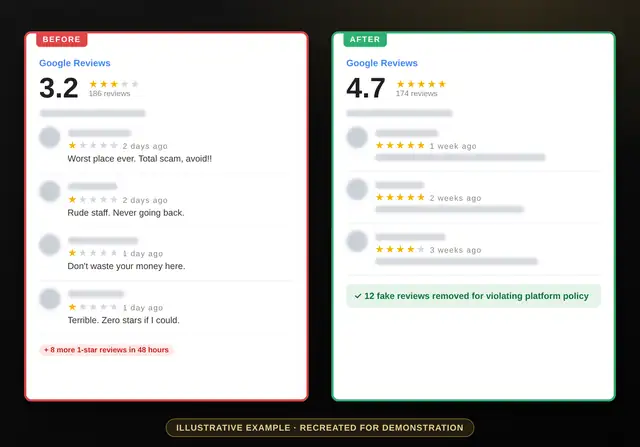
See more results in our review removal case studies.
Google Review Removal Success Rates: FAQs
What percentage of flagged Google reviews are removed?
Google does not publish this figure. Outcomes depend mainly on whether the review breaks a policy and how well it is reported.
Which reviews are easiest to remove?
Spam, hate speech, threats, personal information and reviews about the wrong business.
Which reviews are hardest to remove?
Honest negative opinions, which are allowed, and fake reviews that look genuine without evidence.
Does a lawyer improve success rates?
For defamation cases that meet the legal test, a lawyer can help. For most policy violations, it is not necessary.
Can a professional remove any review?
No legitimate service can remove every review. A good one will assess honestly and refund you if a review is not removed.
How fast are successful removals?
We usually remove reviews within 96 hours. See how long removal takes.
Find out your review’s real odds
Send us the link for a free, honest assessment. Fixed price per review and a 100% refund if it is not removed.