Industry Playbook · Dental Practices
Google Review Removal for Dentists: A Confidential Playbook for Dental Practices (2026-2027)
Dental practices face a unique problem: patients can say anything in a review, but you can’t reply with the facts without risking patient confidentiality. This playbook shows dentists how to spot removable reviews, gather evidence without breaching privacy, reply safely and protect the practice’s rating long term.
Key takeaways
- Dental reviews heavily influence new patient bookings, so a few unfair 1-stars can hurt quickly.
- Confidentiality rules (HIPAA in the US, GDPR and GDC standards in the UK) mean you must never confirm someone was a patient in a reply.
- Fake, competitor, ex-employee, off-topic and abusive reviews can be removed under Google’s policies.
- You can check your records privately to support a removal request without disclosing anything publicly.
- Professional removal is discreet and never needs your Google login.
In this playbook
Can Dentists Remove Bad Google Reviews?
Yes, when the review breaks Google’s rules or the law. Dentists can have reviews removed that are fake, posted by competitors or former staff, off-topic, abusive or that share private information. Honest opinions about treatment or waiting times usually stay. The key difference for dentists is confidentiality: you must build your case privately and keep public replies generic. Our Google review removal for dentists service handles this discreetly, usually within 96 hours.
Why Google Reviews Matter So Much for Dentists
Choosing a dentist is a trust decision, and most people check reviews first. BrightLocal’s Local Consumer Review Survey shows consumers routinely read reviews before choosing local healthcare providers. Nervous patients in particular look for reassurance about pain, gentleness and cost. One vivid 1-star review about a painful extraction can outweigh dozens of short positive ones. Read more about the business effect in the impact of negative Google reviews.
Common Fake and Unfair Review Patterns in Dental Practices
| Pattern | What it looks like | Removable? |
|---|---|---|
| Non-patient review | Complaint about treatment from someone not in your records | Yes — fake engagement |
| Competitor practice | Reviews praising a nearby practice while attacking yours | Yes — conflict of interest |
| Former employee | A dental nurse or receptionist reviewing as a “patient” | Yes — conflict of interest |
| Insurance or NHS policy rant | Anger about funding rules, not your care | Often — off-topic |
| Price shock | “Way too expensive” after a quote | Usually no — opinion |
| Clinical accusations | False claims of malpractice or unqualified staff | Possibly — defamation route |
Want a review gone without the guesswork?
Send us the link for a free check. We tell you within hours whether it can be removed — you only pay once we confirm.
Confidentiality Rules Dentists Must Follow
In the US, HIPAA forbids disclosing protected health information, and the HHS Office for Civil Rights has fined dental practices for revealing patient details while replying to online reviews. In the UK, the GDC’s standards require dental professionals to protect patients’ information, and UK GDPR treats health data as special category data. In practice:
- Never confirm or deny that the reviewer is a patient.
- Never mention treatment, appointments, X-rays or payment history.
- Do check your own records privately to see whether the person is a patient — this supports your removal request without public disclosure.
Step-by-Step: Removing an Unfair Review for Dental Practices
1Screenshot and log the review
Record the reviewer name, date, star rating and exact text.
2Check your practice management system privately
Search for the name and any details. No record is strong evidence for a fake engagement report. Do not share patient details with Google.
3Match the review to a policy
Use our policy violations checklist — fake engagement, conflict of interest, off-topic or harassment.
4Report from the practice’s Business Profile
Choose the most accurate reason, then track it in Google’s review management tool.
5Appeal once with non-clinical evidence
For example: “No person with this name or matching details exists in our records for the period described.”
6Use the legal route for false clinical claims
False allegations of malpractice may be defamatory. See defamatory review removal and Google’s legal removal form.
How to Reply Safely
Keep replies short and generic. For example:
“Thank you for your feedback. Patient care and comfort are our priority, but to protect privacy we can’t discuss any individual online. Please contact our practice manager on [phone/email] so we can talk this through.”
More examples are in our reply templates.
Long-Term Review Strategy for Dental Practices
- Ask every patient for a review after check-out by text or email, without screening for happy patients first.
- Display a QR code at reception and on aftercare leaflets.
- Respond to positive reviews as well, without mentioning treatment.
- Monitor weekly and act fast on clusters — see the review bombing guide.
- Never offer discounts or free whitening for reviews.
For a wider reputation plan, read reputation management for dentists. Doctors and clinics should see Google review removal for medical practices.
What Review Removal Looks Like
Before-and-after results from ReviewsEraser clients.
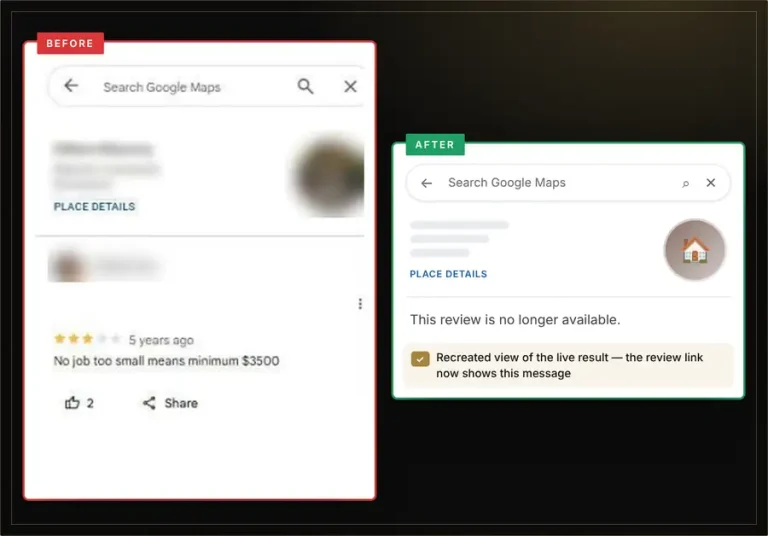
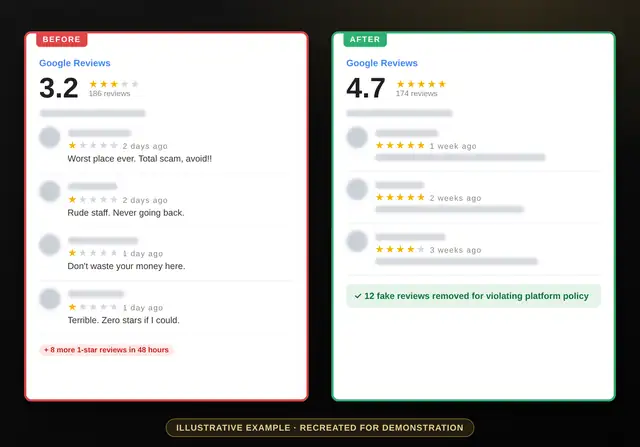
See more results in our review removal case studies.
Dental Practices Review Removal: FAQs
Can a dentist delete a patient’s Google review?
No. Only Google or the reviewer can remove it. Dentists can report reviews that break Google’s rules.
Can I say the reviewer was never a patient?
Saying you can find no record is generally safer than confirming or denying anything about a specific person. Keep public replies generic.
Will Google remove a review about pain or cost?
Usually not, if it is an honest opinion. Reply professionally and ask other patients for reviews.
Are reviews from ex-staff removable?
Yes. Current and former employees reviewing their workplace is a conflict of interest.
Is removal confidential?
Yes. We work under NDA and never contact the reviewer.
How fast can you remove dental reviews?
Usually within 96 hours, with a 100% refund if a review is not removed.
Unfair review hurting your practice?
Discreet, confidential removal under NDA. No login needed, never contacting the reviewer, fixed price per review and a 100% money-back guarantee.