Google Review Policy Violations: What Gets Reviews Removed
PROTECT YOUR REPUTATION
We Remove Damaging Google Reviews in 12 Hours
100% money-back guarantee · Only £99 to start · Trusted by 5,000+ businesses worldwide
Get Free Analysis →Google’s Review Content Policies Explained
Google’s content policies for reviews are designed to ensure reviews are helpful, honest, and relevant. When a review violates these policies, it can be reported and potentially removed. Here are the key policies every business owner should know.Spam and Fake Content
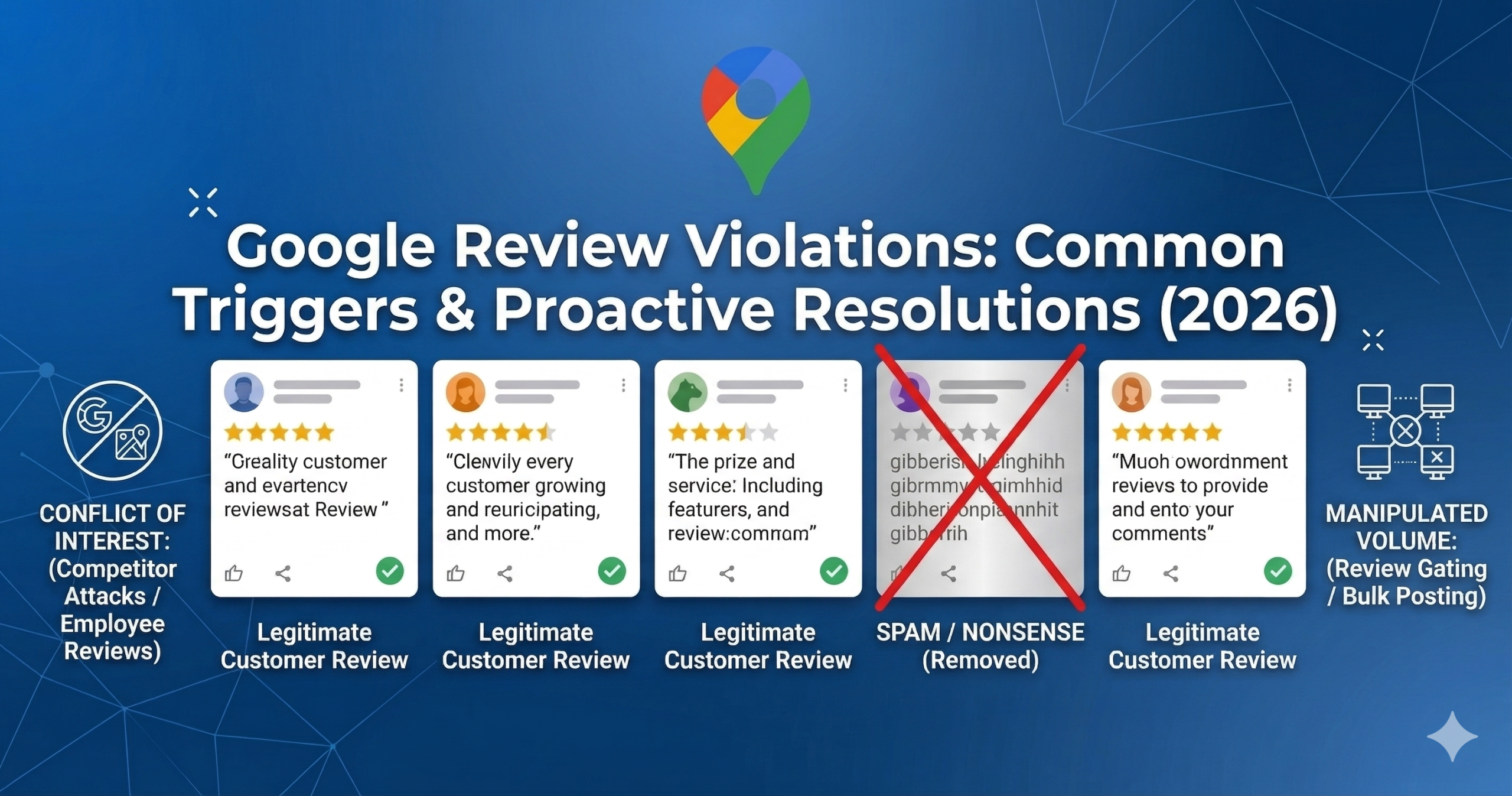
Google prohibits reviews that are fake, duplicate, or posted to manipulate ratings. This includes reviews from people who never used your product or service, reviews posted by competitors to damage your reputation, mass-produced reviews from click farms, and duplicate reviews posted across multiple locations. If you suspect a review is fake or from a competitor, this is one of the strongest grounds for removal.Off-Topic Reviews
Reviews must be relevant to the business or location being reviewed. A review that discusses personal grievances unrelated to the business experience, political opinions, or social commentary rather than an actual customer experience violates this policy.Restricted Content
Google doesn’t allow reviews containing illegal content, sexually explicit material, dangerous or harmful information, or content that promotes illegal activities. Reviews mentioning illegal transactions or unlawful behaviour can be flagged for immediate removal.Deceptive Content
Reviews that misrepresent the reviewer’s identity, affiliation, or experience are deceptive. This includes employees reviewing their own business, reviews from people with a financial conflict of interest, and reviews that impersonate other people.Hate Speech and Harassment
Reviews containing discriminatory language, threats, personal attacks, or harassment based on race, gender, religion, or other protected characteristics are strictly prohibited. These reviews should be flagged immediately.Personal and Confidential Information
Reviews that share personal information such as phone numbers, email addresses, physical addresses, or financial information of individuals violate Google’s privacy policies.How to Identify Policy-Violating Reviews
Not every negative review violates Google’s policies. A genuine customer expressing legitimate dissatisfaction is allowed, even if it hurts. Here’s how to identify Google review policy violations and tell the difference between a legitimate negative review and one that breaks the rules. Signs of a fake review: The reviewer has no other reviews or a suspicious review history, the review doesn’t mention specific details about their experience, the review appeared around the same time as other negative reviews (review bombing), or you can’t find any record of this person as a customer. Signs of a competitor attack: The reviewer is associated with a competing business, the review uses industry jargon that real customers typically wouldn’t know, or multiple negative reviews appeared simultaneously from accounts with similar patterns. Signs of policy violation: The review contains profanity, threats, or hate speech, the review discusses something unrelated to your business, or the review shares private information about staff or other customers.Step-by-Step: Reporting Policy Violations to Google
Method 1: Flag Through Google Maps
Navigate to your business on Google Maps, find the violating review, click the three-dot menu, and select “Report review.” Choose the violation category that best matches the issue. Our complete flagging guide walks through this process in detail.Method 2: Google Business Profile Dashboard
Log into your Google Business Profile, navigate to the Reviews section, find the review, and use the built-in reporting tool. The dashboard method sometimes provides additional reporting options not available through Maps.Method 3: Google’s Review Management Tool
Google’s dedicated Review Management Tool allows you to appeal reviews that weren’t removed after initial flagging. This is your second chance at removal through a more detailed review process.Method 4: Contact Google Support Directly
For clear-cut policy violations that weren’t addressed through flagging, you can contact Google Business Support. Provide evidence of the violation, including screenshots, documentation proving the reviewer wasn’t a customer, and specific policy references.What to Do When Google Won’t Remove a Violating Review
Google’s moderation team processes millions of reports and makes errors. Reviews that clearly violate policies sometimes survive the flagging process. This is frustrating but common — Google’s automated systems and human moderators aren’t perfect. When standard channels fail, professional Google review removal services offer the most reliable path to removal. Reviews Eraser uses advanced legal and policy-based strategies that go far beyond simple flagging. Our team understands the nuances of Google’s policies and knows exactly how to present removal requests for maximum success.Preventing Policy-Violating Reviews
While you can’t entirely prevent Google review policy violations or malicious reviews, proactive reputation management reduces your vulnerability. Build a strong base of positive reviews so that occasional negative ones have minimal impact. Monitor your reviews daily to catch violations quickly. Respond professionally to all reviews — this can sometimes deter attackers who want a reaction. Document suspicious review patterns for use in removal requests.Know Your Rights — Take Action
Every review that violates Google’s policies is a review you have grounds to remove. Don’t accept damaging reviews as inevitable. Reviews Eraser offers a free eligibility check — paste your review link and we’ll assess whether it violates Google’s policies and can be removed within 12 hours.Take Control of Your Online Reputation
Free eligibility check — paste your review link and see what we can remove.
Remove My Review Now →✓ 100% Refund if Not Removed · ✓ 12-Hour Turnaround · ✓ Worldwide Service
How to Use Google Review Policy Violations to Protect Your Business
Understanding Google review policy violations in depth gives you a significant advantage when dealing with fake or harmful reviews. Knowledge of these policies is the foundation of any successful review removal strategy — whether you’re flagging reviews yourself or working with a professional service like ReviewsEraser. A recent feature on Yahoo Finance highlighted ReviewsEraser’s expert approach to identifying and acting on Google review policy violations — helping businesses achieve removal results that far exceed what standard flagging can achieve.Google’s Review Policy Enforcement in 2026
Google’s approach to review policy enforcement has evolved significantly in recent years. The company now uses a combination of automated machine learning systems and human review teams to assess flagged content. While this has improved detection of obvious spam and fake reviews, subtle violations still frequently slip through the automated systems. This is why professional knowledge of how to frame and escalate violation reports is so valuable. Understanding exactly how Google’s enforcement teams assess cases allows expert services like ReviewsEraser to build removal cases that are far more persuasive than standard flag submissions.Lesser-Known Google Review Policy Violations
Beyond the well-known violations like fake reviews and hate speech, there are several lesser-known policy violations that many businesses don’t know they can act on:- Reviews mentioning legal matters: Reviews that make claims related to ongoing legal disputes or lawsuits may be removable to preserve legal process integrity.
- Reviews from multiple accounts: If the same person creates multiple accounts to leave multiple negative reviews, this is a clear spam violation.
- Reviews about a different business: If the reviewer clearly visited or contacted the wrong business and reviewed yours by mistake, this is an off-topic violation.
- Reviews containing competitor advertisements: Reviews that include links to or recommendations of competing businesses violate Google’s advertising policies within reviews.
- Reviews posted by account farms: When groups of fake accounts are used to mass-post negative reviews, this is a serious spam violation that can lead to bulk removal.
Building a Strong Case for Policy Violation Removal
When you identify a Google review policy violation, building a strong removal case requires:- Identifying the specific Google policy being violated (with policy reference)
- Gathering supporting evidence (screenshots, transaction records, reviewer profile analysis)
- Documenting the timeline and any communication history related to the review
- Submitting a clear, factual, professionally written removal request
- Following up and escalating if the initial request is not actioned
Related Resources for Review Removal
To maximise your understanding of how to remove policy-violating reviews, explore these additional guides:- How to flag a Google review — step-by-step flagging process
- Can you remove a fake Google review? — options for fake reviews
- How many reports does it take to remove a Google review?
- How to delete Google reviews — all methods explained
- How to remove bad Google reviews